Ministerial transition booklet
Table of contents
CanNor's Minister
The Honourable Rebecca Chartrand

The Honourable Rebecca Chartrand is an Anishinaabe, Inninew, Dakota, and Métis leader, educator, and long-time advocate for Indigenous and northern communities and has deep roots in Treaty 1 and Treaty 5. She brings a proven track record of tackling critical issues such as poverty reduction, anti-racism, suicide prevention, health, safety, and justice.
A bridge-builder at heart, Rebecca is committed to amplifying northern and Indigenous voices. At the core of her vision is partnerships economic sovereignty, climate-smart infrastructure, and creating real opportunities in housing, health, and education—ensuring northern communities thrive now and for future generations.
CanNor
Vision
A strong, diversified, sustainable, and dynamic economy for Northerners and Indigenous Peoples, communities, and businesses across Canada's territories, guided by the Agency's Pan-Territorial Growth Strategy and in contribution toward Canada's prosperity.
Overview
Regional Development Agencies (RDAs) address key economic challenges within their respective regions through tailored programs and services while supporting the Government of Canada with regional knowledge and expertise.

Text alternative for: CanNor fosters economic development in Canada's territories
A map showing the respective regions of Canada's seven RDAs:
- Canadian Northern Economic Development Agency (CanNor)
- Pacific Economic Development Canada (PacifiCan)
- Prairies Economic Development Canada (PrairiesCan)
- Federal Economic Development Agency for Northern Ontario (FedNor)
- Canada Economic Development for Quebec Regions (CED)
- Atlantic Canada Opportunities Agency (ACOA)
- Federal Economic Development Agency for Southern Ontario (FedDev)
CanNor fosters economic development in Canada's territories by:
- delivering a suite of economic development programs, including Indigenous-specific programs
- building partnerships that leverage investments
- coordinating federal participation in territorial environmental review processes through the Northern Projects Management Office
- maintaining a Crown consultation record for major projects
- funding skills development opportunities
- championing the interests of Northerners and Indigenous Peoples
- ensuring Government of Canada obligations under Article 23 of the Nunavut Agreement through Pilimmaksaivik
Pan-Territorial Growth Strategy
CanNor's objectives are guided by its Pan-Territorial Growth Strategy, which highlights four interrelated areas of action:

Skilled Workforce
Strengthen the northern workforce and equip Northerners with the tools, skills, and experience they need to succeed in the workforce, now and into the future.

Infrastructure Investments and Development
Leverage upcoming investments and the ongoing operation of major infrastructure projects to maximize local and regional economic opportunities.

Resource Development
Support the sustainable development of the mining and energy sectors throughout the development cycle, in a manner which increases community capacity, maximizes jobs and wealth within the territories, and produces positive economic impacts in communities.

Diversification and Innovation
Foster the sustainable growth of other economic sectors with a focus on strengthened entrepreneurship and northern innovation.
Nunavut Overview
Demography
| Estimated Total Population (2024) | 41,159 |
|---|---|
| Median Age of Population (2024) | 26.8 |
| % Indigenous Population (2021) | 86% |
Labour Force Statistics (Age 15+, February 2025, Seasonally-Adjusted)
| Labour Force | Nunavut | Canada |
|---|---|---|
| Unemployment Rate | 7.8% | 6.6% |
| Labour Force Participation Rate | 58.1% | 65.3% |
| Employment Rate | 53.6% | 61.1% |
| Source: Statistics Canada – Tables 17-10-0005-01, 14-10-0292-01 & 14-10-0287-01 | ||

Text alternative for: Sectoral Breakdown (2024)
A pie chart showing the sectoral breakdown of Nunavut's GDP as of 2024:
- Public sector – 28%
- Mining, quarrying and oil and gas extraction – 36%
- Construction – 10%
- Retail trade – 3%
- Transportation and warehousing – 2%
- Real estate and rental and leasing – 7%
- Arts, information and culture – 2%
- Accommodation and food services – 2%
- Other – 10%Footnote 1
Source: Statistics Canada – Table 36-10-0402-01
Challenges:
- Limited infrastructure including housing, roads, broadband
- High unemployment; skills mismatch
Opportunities:
- Diversifying the economy, including a developing film industry
- Major energy, road, and port infrastructure projects
- Young population has potential to meet labour force needs
Northwest Territories Overview
Demography
| Estimated Total Population (2024) | 44,731 |
|---|---|
| Median Age of Population (2024) | 36.0 |
| % Indigenous Population (2021) | 50% |
Labour Force Statistics (Age 15+, February 2025, Seasonally-Adjusted)
| Labour Force | Northwest Territories | Canada |
|---|---|---|
| Unemployment Rate | 4.1% | 6.6% |
| Labour Force Participation Rate | 70.6% | 65.3% |
| Employment Rate | 67.7% | 62.2% |
| Source: Statistics Canada – Tables 17-10-0005-01, 14-10-0292-01 & 14-10-0287-01 | ||

Text alternative for: Sectoral Breakdown (2024)
A pie chart showing the sectoral breakdown of Northwest Territories's GDP as of 2024:
- Public sector – 38%
- Mining, quarrying and oil and gas extraction – 15%
- Construction – 7%
- Retail trade – 5%
- Transportation and warehousing – 7%
- Real estate and rental and leasing – 11%
- Arts, information and culture – 3%
- Accommodation and food services – 3%
- Other – 11%
Source: Statistics Canada – Table 36-10-0402-01
Challenges:
- Long-term outlook slumping due to aging out of existing mines
- Population aging in medium-term
- Outmigration of skilled labour
- Low private investments hindering innovation and competition
Opportunities:
- New infrastructure (e.g., roads, power) can spur new projects
- Opportunities exist in critical mineral
Yukon Overview
Demography
| Estimated Total Population (2024) | 46,704 |
|---|---|
| Median Age of Population (2024) | 38.4 |
| % Indigenous Population (2021) | 22% |
Labour Force Statistics (Age 15+, August 2024, Seasonally-Adjusted)
| Labour Force | Yukon | Canada |
|---|---|---|
| Unemployment Rate | 4.5% | 6.6% |
| Labour Force Participation Rate | 77.5% | 65.3% |
| Employment Rate | 74.0% | 61.1% |
| Source: Statistics Canada – Tables 17-10-0005-01, 14-10-0292-01 & 14-10-0287-01 | ||

Text alternative for: Sectoral Breakdown (2024)
A pie chart showing the sectoral breakdown of Yukon's GDP as of 2024:
- Public sector – 39%
- Mining, quarrying and oil and gas extraction – 7%
- Construction – 10%
- Retail trade – 5%
- Transportation and warehousing – 4%
- Real estate and rental and leasing – 14%
- Art, information and culture: 3%
- Accommodation and food services – 4%
- Other – 14%
Source: Statistics Canada – Table 36-10-0402-01
Challenges:
- Labour availability; housing shortage
- Closure of mines and challenges to future development
- Population aging in medium-term
Opportunities:
- Economic collaboration with Alaska, especially on Arctic securitization
- Growing innovation ecosystem; rebounding tourism industry
- Major planned infrastructure initiatives and upgrades
Key Partners
CanNor works with a number of partners and stakeholders in the territories, including territorial governments, other federal departments, Indigenous governments and organizations, communities, and industry.
Territorial Governments
CanNor works with key departments of territorial governments in support of economic development. Territorial priorities inform the design of CanNor's programming as well as its advocacy work across the federal government. CanNor and territorial governments also work to align programming, identifying and addressing gaps. For example, CanNor and the Government of Yukon co-funded Yukonstruct Makerspace, supporting the region's innovation ecosystem. In fall 2023, CanNor also contributed $1 million to the Government of the Northwest Territories to support small businesses impacted by wildfires and evacuation orders.
Territorial Indigenous Organizations
The North is distinct from most other regions in the country given the significant role played by Indigenous businesses in the economy, particularly Indigenous Economic Development Corporations, which are some of the largest businesses headquartered in the territories. These corporations are part of a growing number of community enterprises in the North, pursuing both economic and social gains.
Federal Partners
There are 25 federal departments and agencies that provide programs, funding and policy development in the North. CanNor collaborates with other government departments to capitalize on the North's immense opportunities and fuel economic growth.
Industry
The private sector is a key partner in the North, investing in businesses, infrastructure, employment, and training; it is also a source of research, development, and cold-climate innovation.
Key Programs
CanNor provides financial support to small- and medium-sized enterprises (SMEs), communities, territorial and Indigenous governments, and organizations through both non-repayable and repayable contributions and grants.
CanNor-Specific Programming

Inclusive Diversification and Economic Advancement in the North (IDEANorth): $18.2MFootnote 2 per year ongoing; $11MFootnote 2 per year in top-up from 2024-25 to 2026-27. Promotes economic diversification and growth through four streams:
- Foundational investments to advance economic growth and sector development.
- Business scale-up, productivity, and support to business research and development.
- Small-scale economic infrastructure development.
- Advancing foundational economic infrastructure.

Northern Indigenous Economic Opportunities Program (NIEOP): Supports development for Indigenous communities and businesses. $10.8MFootnote 2 per year ongoing; $2.4MFootnote 2 per year in top-up through 2026-27. Delivers:
- The Community Readiness and Opportunities Planning (CROP) fund, which improves the economic development capacity of Indigenous communities.
- The Entrepreneurship and Business Development (EBD) fund, which assists Indigenous entrepreneurs and businesses through project-based support.
- A new Economic Research Funding strengthens the territorial Indigenous business space through economic research and knowledge development.

Northern Isolated Community Initiatives Fund (NICI): Supports community-led projects for local/Indigenous food production. $7.5MFootnote 2 over three years (until 2026-27).
National Programs Delivered by All RDAs

Regional Economic Growth Through Innovation (REGI): $10.2MFootnote 2 over two years (until 2025-2026) to support development of regional innovation ecosystems and scaling up of businesses, of which at least $310K is allocated to supporting local innovative housing solutions.
An additional $3.3MFootnote 2 from 2024-25 to 2028-29 supports AI adoption programming for Northern businesses and organizations.

Tourism Growth Program (TGP): $795KFootnote 2 per year until 2025-2026, supporting economic diversification in the territories and helping to expand and enhance local tourism products and experiences.
Key Services
Northern Projects Management Office
NPMO was established in 2010 to improve the efficiency of the federal environmental review process for proposed resource development and infrastructure projects in the territories.
NPMO's functions include:
- coordinating federal departments' participation in all of the environmental assessment processes of major projects in the North;
- providing issues management in relation to environmental assessments for Indigenous organizations and industry proponents; and
- overseeing and coordinating Crown consultations in relation to major projects.
Policy & Advocacy
CanNor provides strategic and program policy advice with regard to economic development, diversification, and opportunities in the North. It also champions the economic interests of the North within and outside government.
CanNor's policy development is informed by sectoral research and analysis, close working relationships with key stakeholders, partners, and other departments, and CanNor's own work in the North.
Pilimmaksaivik
CanNor hosts Pilimmaksaivik, the Federal Centre of Excellence for Inuit Employment in Nunavut. Pilimmaksaivik is an Inuktitut term chosen by federal Inuit employees, meaning 'a place to develop skills through observations, mentoring, practice, and effort.'
Pilimmaksaivik is responsible for coordinating a whole of government approach to building a representative federal public service in Nunavut, as described under Article 23 of the Nunavut Agreement. Article 23 commits to the employment of Inuit within Nunavut at a level commensurate with their demographic representation (i.e., approximately 85%).
Pilimmaksaivik works toward this by reducing barriers for recruitment, designing and delivering cultural competency training, and coordinating workplace wellness activities.
Specific Pilimmaksaivik initiatives include:
- the Inuit Learning and Development Program (ILDP), a pre-employment and job training initiative aimed at helping Nunavut Inuit develop skills for potential jobs in the federal public service within the territory;
- the Ilipallianniq Education Support Fund, which provides financial support to Inuit employees across federal departments pursuing post-secondary studies that correlate with Government of Canada positions in Nunavut;
- Sivuliqtiurnimut Ilinniarniq, a leadership training initiative that prepares Inuit employees to take on supervisory or manager-level employment; and
- cultural and wellness support to Inuit employees across the Government of Canada via one-on-one counselling sessions.
On March 8, 2025 the Federal Government with the Government of Nunavut and Nunavut Tunngavik Inc. (NTI) signed the co-developed Nunavut Agreement Implementation Contract, committing new resources for Pilimmaksaivik.
Financial Information
Statutory Vs. Voted Spending
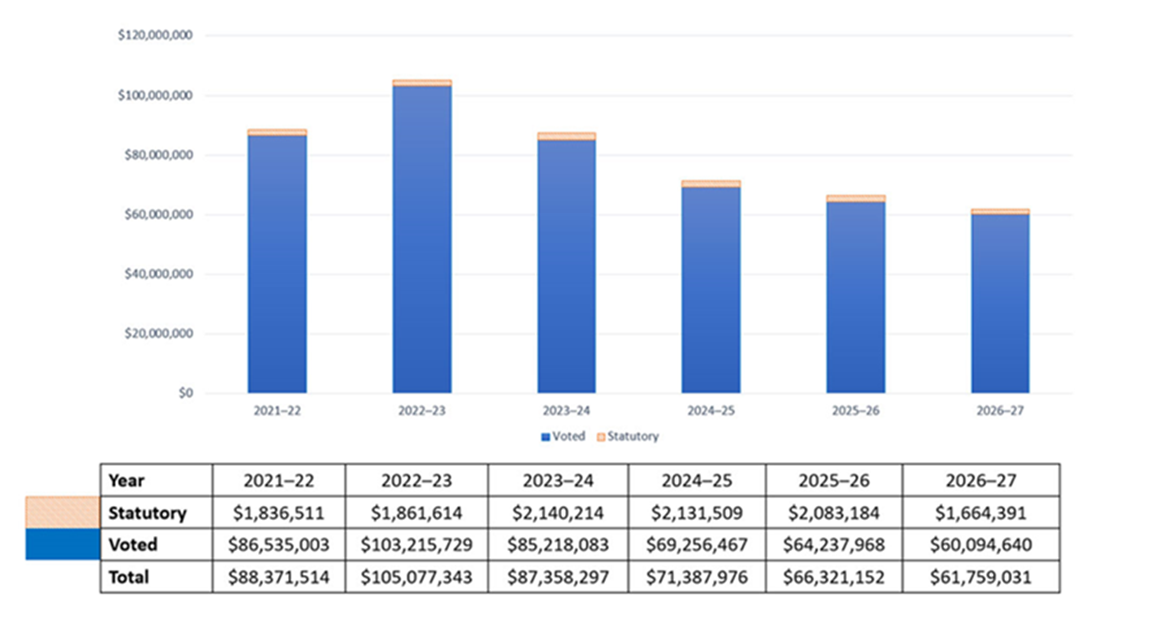
Text alternative for Statutory Vs. Voted Spending
A chart showing the total spending, voted spending, and statutory spending from 2021-22 to 2026-27:
2021-2022
- Statutory: $1,836,511
- Voted: $86,535,003
- Total: $88,371,514
2022-2023:
- Statutory: $1,861,614
- Voted: $103,215,729
- Total: $105,077,343
2023-2024:
- Statutory: $2,140,214
- Voted: $85,218,083
- Total: $87,358,297
2024-2025:
- Statutory: $2,131,509
- Voted: $69,256,467
- Total: $71,387,976
2025-2026:
- Statutory: $2,083,184
- Voted: $64,237,968
- Total: $66,321,152
2026-2027:
- Statutory: $1,664,391
- Voted: $60,094,640
- Total: $61,759,031
Full-Time Equivalents
| Core responsibilities and internal services | 2021–22 actual full time equivalents |
2022–23 actual full time equivalents |
2023-24 actual full time equivalents |
2024-25 planned full time equivalents |
2025-26 planned full time equivalents |
2026-27 planned full time equivalents |
|---|---|---|---|---|---|---|
| Internal services | 29 | 32 | 33 | 31 | 31 | 31 |
| Economic development in the territories | 89 | 80 | 83 | 93 | 93 | 92 |
Text alternative for: Full-Time Equivalent
A table showing the information on human resources, in full-time equivalents (FTEs), for each of CanNor's core responsibilities and for its internal services from 2021-2022 – 2026-2027:
2021-2022
- Internal services: 29
- Economic development in the territories: 89
- Total: 118
2022-2023:
- Internal services: 32
- Economic development in the territories: 80
- Total: 112
2023-2024:
- Internal services: 33
- Economic development in the territories: 83
- Total: 116
2024-2025:
- Internal services: 31
- Economic development in the territories: 93
- Total: 124
2025-2026:
- Internal services: 31
- Economic development in the territories: 93
- Total: 124
2026-2027:
- Internal services: 31
- Economic development in the territories: 92
- Total: 123
Figures reflect the 2023-24 Departmental Results Report. In addition, the decrease in planned spending from 2024-25 and onward is primarily a result of the sunsetting of Budget-related initiatives and partial funding reduction of the IDEANorth program.
The planned FTEs are stabilized for the next three years based on the Budget 2023's renewal of the CanNor's flagship program: Inclusive Diversification and Economic Advancement in the North.