Canadian Northern Economic Development Agency 2024-25 Departmental Results Report
PDF Version (820 KB, 35 pages)
Table of contents
Copyright information
© His Majesty the King in Right of Canada, as represented by the Minister of Northern and Arctic Affairs and Minister responsible for the Canadian Northern Economic Development Agency, 2025.
Catalogue: R105-3E-PDF
ISSN: 2561-2921
Aussi disponible en français sous le titre : Rapport sur les résultats ministériels 2024-2025
At a glance
This departmental results report details the Canadian Northern Economic Development Agency's (CanNor) actual accomplishments against the plans, priorities and expected results outlined in its 2024-25 Departmental Plan.
Key priorities
CanNor identified the following key priorities for 2024-25:
- Promote long term job creation and build resilient economies in the territories by:
- Strengthening business and community development through the delivery of a suite of funding programs that foster growth and innovation;
- Helping Northerners meet their housing needs by supporting efforts to enhance the territorial construction ecosystem;
- Encouraging economic development outside the territorial capitals by building on ongoing outreach activities with rural communities in the territories;
- Advancing consultation tools to ensure the federal Duty to Consult processes are completed in a collaborative, effective and efficient manner in support of critical mineral and resource development, and major infrastructure projects in the North; and,
- Engaging with territorial tourism entities to support impactful regional projects that will encourage sector growth through initiatives that build on ongoing successes in international tourism markets.
- Support Canada's reconciliation journey by:
- Working directly with Indigenous communities to ensure they are positioned to take advantage of economic development opportunities in ways that support the economic goals and objectives of the Arctic and Northern Policy Framework, as well as the implementation of the Inuit Nunangat Policy and the United Nations Declaration on the Rights of Indigenous Peoples Act;
- Implementing the Economic Research Stream of the Northern Indigenous Economic Opportunities Program, in collaboration with Indigenous partners, to strengthen the territorial Indigenous business space through economic research and knowledge development; and,
- Continuing to implement Article 23 of the Nunavut Agreement through Pilimmaksaivik's strategic coordination of a government-wide approach to delivering innovative recruitment and training initiatives for Nunavut Inuit.
Highlights for CanNor in 2024-25
- Total actual spending (including internal services): $80,976,370
- Total full-time equivalent staff (including internal services): 116
For complete information on CanNor's total spending and human resources, read the Spending and human resources section.
Summary of Results
The following provides a summary of the results the department achieved in 2024-25 under its main areas of activity, called "core responsibilities."
Core responsibility 1: Economic development in the territories
Actual spending: $72,244,695
Actual full-time equivalent staff: 86
- People and communities participate in the economy in the territories
- Through the Northern Indigenous Economic Opportunities Program (NIEOP), CanNor funded 53 projects for a total of $13.2 million to support Indigenous economic participation, business development and economic research.
- Through Pilimmaksaivik, CanNor continued to implement Article 23 of the Nunavut Agreement and ensure that the Government of Canada's responsibilities and commitments were met.
- Businesses are developing in the territories
- Through the Inclusive Diversification and Economic Advancement in the North (IDEANorth) and the Regional Economic Growth Through Innovation (REGI) programs, CanNor funded 187 projects for a total of approximately $35.8 million to support Northerners, entrepreneurs, businesses and small- to medium-sized enterprises (SMEs) to innovate, grow, improve productivity, attract new investments, build new infrastructure, and diversify the territorial economies.
- The environmental review process in the territories is efficient and predictable
- Through its Northern Projects Management Office (NPMO), CanNor oversaw and coordinated Crown consultations for 15 major projects, such as the Mary River Steensby project, and provided 52 companies with advisory services.
For more information on CanNor's economic development in the territories read the ‘Results – what we achieved' section.
From the Minister

I am pleased to present the 2024-25 Departmental Results Report for the Canadian Northern Economic Development Agency (CanNor).
Over the past year, as CanNor marked 15 years of operations, the Agency continued to champion economic development in the North. Staying true to its core mandate, CanNor advanced diversified, sustainable, and dynamic territorial economies, an effort that strengthens not only the North, but the Canadian economy as a whole.
Northerners embody innovation in everything they do. CanNor remains well positioned to support this spirit through focused, collaborative, and results-driven engagement with territorial governments, and in partnership with First Nations, Inuit, and Métis.
Through its suite of targeted funding programs, CanNor delivered both short- and long-term strategic investments. These investments supported economic infrastructure, expanded supply chains and market access for small businesses, created jobs, fostered innovative approaches to food security, and contributed to strategies addressing housing and overcrowding challenges in the territories.
Pilimmaksaivik, the Federal Centre of Excellence for Inuit Employment in Nunavut, continued to advance a whole-of-government approach to implementing Article 23 of the Nunavut Agreement, with the goal of building a representative public service in the territory.
Through the Northern Projects Management Office (NPMO), CanNor also maintained its leadership in coordinating the federal presence in territorial impact assessments for major projects. By supporting a collaborative, efficient, and effective federal Duty to Consult process, NPMO plays a key role in ensuring responsible development of the North's critical resources for the benefit of Northerners and all Canadians.
As CanNor looks ahead to the next 15 years, I invite you to explore this report to learn more about the Agency's work and its continued contributions to economic growth and prosperity across the territories.
______________________________________________
The Honourable Rebecca Chartrand
Minister of Northern and Arctic Affairs and Minister responsible for the Canadian Northern Economic Development Agency
From the President

CanNor's 15th anniversary marked a meaningful opportunity to connect in person with colleagues across our offices in Whitehorse, Yellowknife, Iqaluit and Ottawa. Through meetings with partners, businesses, and organizations that have benefited from the Agency since its creation in 2009, I was reminded of the real and lasting impact CanNor continues to have in the North. It was a privilege to witness these successes firsthand.
CanNor continued to play a pivotal role in 2024-25, supporting entrepreneurs and organizations across the territories through its suite of economic development programming. We also made positive, strategic investments in infrastructure, fostering responsible and sustainable resource development, and continued our collaboration to support projects and major works that address the gaps of today and leverage the new economic opportunities for tomorrow.
Pilimmaksaivik (the Federal Centre of Excellence for Inuit Employment in Nunavut), housed within CanNor, is responsible for coordinating a whole-of-government approach to building a representative federal public service in Nunavut. This year culminated in a new 10-year whole-of-government Inuit Employment Plan for the Government of Canada, in accordance with its obligations under Article 23 of the Nunavut Agreement. Pilimmaksaivik also opened its new, inclusive office space in Iqaluit, designed to better support Inuit in accessing programs and services that help them pursue employment with the Government of Canada and build the skills needed for future leadership roles in the territory and across the country.
CanNor's Northern Projects Management Office (NPMO) continued to play a key coordinating and convening role to support federal participation in environmental assessment and regulatory review processes for proposed major resource development and infrastructure projects in the North. NPMO also continued to ensure the adequacy of Crown consultations with Indigenous governments, groups, organizations and communities, as well as fulfilled its core mandate of pathfinding and convening services for industry, investors, regulatory boards and territorial governments.
CanNor plays a vital role as the only federal agency solely dedicated to economic development in the North. Over its first 15 years, it has established strong, foundational relationships with the private sector and with territorial and Indigenous governments. This year, the Agency continued to make meaningful contributions to northern economic development and is well-positioned to engage, advise, and lead in this new era of growing national and international interest in the North and Arctic.
______________________________________________
Jimi Onalik
President of the Canadian Northern Economic Development Agency
Results – What we achieved
Core responsibilities and internal services
Core responsibility 1: Economic Development in the Territories
In this section
Description
Working in the territories to support the conditions for a sustainable, diversified and innovative economy in collaboration with Northerners/Indigenous Peoples, businesses, organizations, federal departments and other levels of government.
Quality of life impacts
- Prosperity – Making ends meet
- Prosperity – Household income
- Prosperity – Employment
- Prosperity – Youth not in employment, education or training (NEET)
- Prosperity – Core housing need
- Prosperity – Poverty
- Prosperity – Productivity
- Prosperity – Gross domestic product (GDP) per capita
- Prosperity – Protection from income shocks
- Prosperity – Firm dynamism
Progress on results
This section details the department's performance against its targets for each departmental result under Core Responsibility 1: Economic Development in the Territories.
Table 1.1: People and Communities Participate in the Economy in the Territories
This table shows the target, the date to achieve the target and the actual result for each indicator under People and Communities Participate in the Economy in the Territories in the last three fiscal years (FYs).
| Departmental Result Indicators | Target | Date to achieve target | Actual Result |
|---|---|---|---|
| Labour participation rate for women and Indigenous Peoples in the Territories: Indigenous Peoples | Equal or higher than the national averageTable note 1
|
March 31, 2028 |
|
| Labour participation rate for women and Indigenous Peoples in the Territories: Women | Equal or higher than the national averageTable note 1
|
March 31, 2028 |
|
| Amount leveraged per dollar invested in community projects in the Territories | 1.5Table note 3 | March 31, 2025 |
|
|
|||
Table 1.2: Businesses are Developing in the Territories
This table shows the target, the date to achieve the target and actual result for each indicator under Businesses are Developing in the Territories in the last three FYs.
| Departmental Result Indicator | Target | Date to achieve target | Actual Results |
|---|---|---|---|
| Number of businesses by business locations in the Territories | 4,100Table note 4 | March 31, 2025 |
|
| Number of investments in clean tech projects supported by CanNor in the Territories | 10 | March 31, 2028 |
|
|
|||
Table 1.3: Efficient and Predictable Environmental Review Process in the Territories
This table shows the target, the date to achieve the target and actual result for each indicator under Efficient and Predictable Environmental Review Process in the Territories in the last three FYs.
| Departmental Result Indicator | Target | Date to achieve target | Actual Results |
|---|---|---|---|
| Number of companies provided advisory services (Pathfinder) including issues management and support in the environmental assessment and governance processes in the Territories | 50 | March 31, 2025 |
|
| Percentage of environmental assessments in the Territories that are completed within the scheduled time frame | 100% | March 31, 2025 |
|
|
|||
The Results section of the Infographic for CanNor on GC Infobase page provides additional information on results and performance related to its program inventory.
Details on results
The following section describes the results for Economic Development in the Territories in 2024-25 compared with the planned results set out in CanNor's departmental plan for the year.
In 2024-25, the Policy and Advocacy program advanced all three Departmental Results by helping to implement the Arctic and Northern Policy Framework, advocating for Northern priorities, sharing knowledge to enhance federal policy effectiveness in the territories, and cultivating Northern innovation and entrepreneurship through targeted supports.
Key results achieved:
- Promoted place-based economic development at domestic forums (e.g., the Association for Mineral Exploration's RoundUp; the Prospectors and Developers Association of Canada conference; etc.), international forums (e.g., Arctic Circle Assembly, Organization for Economic Co-operation and Development (OECD) Regional Development Policy Committee, etc.) and internal Government of Canada committees and working groups.
- Supported collaborative research and medium-term planning for evaluations of Agency programs and the development of whole-of-government and departmental Inuit Employment Plans.
- Supported the Minister through the provision of timely intelligence and insight on key economic developments, issues and opportunities facing the territories (e.g., briefing, scenario, issue and meeting notes, ministerial transition materials, etc.).
- Contributed to the work of the Standing Committee on Indigenous and Northern Affairs, the Inuit-Crown Partnership Committee, and cross-government Arctic coordination committees at the Deputy Minister and Assistant Deputy Minister levels.
- Provided strategic advice, input, and reviews of proposals for new or renewed financial and spending authorities.
- Led and coordinated agency-wide planning and reporting efforts including the identification of sectoral priorities and drivers of economic development in the territories, analysis of policy and program levers, and provision of actionable advice to decision-makers on pathways for advancement.
- Engaged with external stakeholders and partners on economic development in the territories. For example, CanNor undertook proactive engagement with the National Indigenous Economic Development Board (NIEDB) and the Organization for Economic Co-operation and Development (OECD) to illustrate the coherence between CanNor's activities, NIEDB objectives and OECD principles, and explore best practices in relation to Indigenous, territorial, and sectoral economic development.
- Collaborated with other federal departments to ensure fair representation of CanNor's programs, advocate for Northern needs and regionally appropriate solutions, and promote alignment on Northern policy. For example, the Strategic Policy team led engagements with Fisheries and Oceans Canada (DFO) on opportunities to advance the Arctic Blue Economy – a key economic sector in the North.
People and Communities Participate in the Economy in the Territories
In 2024-25, CanNor worked to advance employment, income and wealth creation by funding capacity-building initiatives that enhanced participation in economic activities, provided targeted support to Indigenous entrepreneurs and businesses for starting or scaling operations, and addressed knowledge gaps in territorial Indigenous economic ecosystems to help unlock greater economic opportunity and prosperity.
Results achieved:
- Delivered approximately $9.9 million to 41 projects through its Community Readiness and Opportunities Planning (CROP) fund, a stream of the Northern Indigenous Economic Opportunities Program (NIEOP). This program provides financial support to Indigenous communities to improve their capacity to participate in economic opportunities.
- For example, in Nunavut, CanNor provided $110,000 in 2024-25, on top of $600,000 in 2023-24, to Cumberland Sound Fisheries Limited (CSFL) to purchase and install a rapid freezing cold storage unit and ten cold storage units to increase product processing and capacity, allowing CSFL to expand and maintain more staff, increase production and reduce their long-term carbon footprint. This investment supported employment and economic development in Nunavut's fishing industry by creating at least six new jobs, increasing work allocated to 15 existing jobs, and maintaining a total of 100 jobs.
- In Yukon, CanNor delivered $279,161 (with additional funds allocated for 2025-26 and 2026-27) to the Ross River Dena Council to pilot the delivery of a remote flight school for Kaska students in Ross River and Faro. This project will see up to four students complete their training and become licensed private and commercial pilots, as well as potentially lead to additional flight training in other remote Northern communities. The Ross River flight school will break down barriers faced by Indigenous Peoples in developing specialized, practical skills and participating in the Northern economy, while helping to bridge the shortage of skilled labour that threatens to disrupt Canada's airline industry.
- Delivered approximately $3 million to eight projects through its Entrepreneurship and Business Development (EBD) Program, a stream of NIEOP, which aims to increase the number of viable Indigenous businesses, promote entrepreneurship in Indigenous communities, and enhance access to capital for Indigenous businesses in the territories. CanNor partners with external service delivery partners with extensive on-the-ground experience to target funding where it can have the largest impacts across the territories.
- For example, CanNor is providing $700,000 over three years, starting with $231,550 funded in 2024-25, to the Nunavut Community Futures Association to deliver the EBD in the Kitikmeot Region in Nunavut. This will facilitate a localized approach to EBD program delivery and support more widespread knowledge of, and engagement with, the EBD program among the 7,143 residents in the region, representing a potential labour force of 4,546 workers.
- Delivered approximately $425,000 to four projects through its Economic Research Stream (ERS), a stream of NIEOP, to support and strengthen the territorial Indigenous business space through Indigenous-led research, knowledge development and mobilization.
- As an example, CanNor provided $115,000 in 2024-2025 (with additional funding committed in 2025-26 and 2026-27) to the Qikiqtani Inuit Association for the "Mapping the Evolution of the Qikiqtani Marine-Capture Fisheries" project to conduct essential research for the advancement of the fisheries sector in Nunavut. The project will examine how Inuit rights are upheld, respected or displaced in the management and development of commercial fisheries in the territory. The project is expected to result in a published book on the history of the fisheries sector in the Qikiqtani Region of Nunavut, and the knowledge generated through this research will help to inform future decision-making at the Qikiqtani Inuit Association and Nunavut Tunngavik Inc. regarding the governance and management of commercial fisheries in Nunavut.
- In the Northwest Territories, CanNor provided $76,000 to the Thebacha Leadership Council (with additional funding in 2025-26 and 2026-27) to support a 3-year project researching economic opportunities related to Whooping Crane conservation, such as crane-focused tourism development, community events and projects, and convening conservationists and conservation organizations.
- In Yukon, CanNor is providing $219,790 in total, with $70,210 spent in 2024-25, to fund the Yukon Soaps Company (YSC) to conduct research on the viability of developing a market for non-timber forest products, including a feasibility report and financial analysis. This research will be guided by Indigenous values and culture.
- Provided approximately $2.5 million to 13 projects across the territories through the Northern Isolated Community Initiatives (NICI), which supports northern food and agriculture businesses by investing in initiatives that strengthen and diversify economic activity, while addressing food security in northern and Indigenous communities.
- For example, CanNor issued $800,000 to Knutsford Ventures Inc. in 2024-25 for the remodeling and major expansion of the Polar Eggs farm to increase production, productivity and capacity and bring the entire Northwest Territories egg quota back within the territory's borders. This project will create new jobs, innovate egg production in the region, help bolster food security and reduce the cost of eggs in Northwest Territories.
- CanNor also delivered $170,646 to the Yukon First Nation Education Directorate Society (YFNEDS) for the procurement of a purpose-built van to support the delivery and expansion of their Urban Nutrition Program. The program will deliver daily meals to 1,100 Indigenous students at nine Whitehorse schools. The project not only addresses food insecurity for vulnerable populations, but will also result in a high return on investment, support local employment and diversify the revenue streams for the not-for-profit YFNEDS.
In 2024-25, CanNor also supported economic participation in the territories by hosting Pilimmaksaivik, the Federal Centre of Excellence for Inuit Employment in Nunavut. The Centre is responsible for coordinating a whole-of-government approach to building a representative federal public service in Nunavut, including upholding its commitments under Article 23 of the Nunavut Agreement. Pilimmaksaivik does this by reducing barriers for recruitment, designing and delivering training that is supportive of Inuit culture and values, and overseeing initiatives that support workplace wellness with an aim to increase Inuit representation across departments and agencies operating in Nunavut.
In 2024-25, Pilimmaksaivik continued to deliver on its mandate by strategically coordinating innovative recruitment and training initiatives for Nunavut Inuit. Key achievements include:
- Conducted three community engagements in Nunavut (Kimmirut, Baker Lake, and Pond Inlet) to inform students, parents and working populations about occupations in the Government of Canada (GC) that are available locally and territorially, and about educational requirements for those positions;
- Conducted one community engagement in the National Capital Region to provide cultural learning opportunities to GC management in the south, giving them a better understanding of Inuit culture and of where their Inuit employees come from and who they are; and,
- Co-managed the Inuksugait Resume Inventory with the Public Service Commission, which provides a direct connection between Nunavut Inuit applicants and GC hiring managers. The inventory included 102 candidates at the end of FY 2024-25 and contributed to several appointments—9 indeterminate external candidates, 7 indeterminate internal candidates, 3 term external candidates, and 2 term internal candidates. The ongoing management of the inventory ensures continuous updates, monthly reviews, and referral requests, with efforts to re-open the recruitment process as needed.
As part of its recruitment role, Pilimmaksaivik continued to deliver intensive outreach and awareness campaigns promoting the GC as an employer of choice. In 2024–25, Pilimmaksaivik organized and participated in five career and job fairs across Iqaluit, Rankin Inlet, and Ottawa. These events aimed to raise awareness of employment opportunities and foster engagement between job seekers, students, and government representatives. Pilimmaksaivik continues to track and analyze attendance and engagement at these fairs to inform and improve future outreach.
In collaboration with GC departmental partners, Pilimmaksaivik shared and promoted best practices in Inuit Employment, provided guidance and support on matters of Inuit Employment, and continued to monitor and report progress. The Inuit Employment Human Resources Network continued its bimonthly meetings to discuss Inuit employment matters, with meetings taking place monthly as of 2024-25. The Annual Report of Article 23 Implementation tracks progress on the Inuit Employment Plan's implementation, with annual reports due for the years 2017-2023 and 2023-2025. The 2023-25 report is on track for completion by the end of FY 2025-26.
In 2024-25, Pilimmaksaivik offered distinctions-based mental-health and wellness strategies by:
- Providing in-person and telephone counselling services for Nunavut Inuit federal employees and planning monthly in-person counselling sessions with Health Canada to ensure that staff have access to support for day-to-day challenges;
- Organizing the Inuit Qaujimajatuqangit (IQ) Cultural Immersion initiative, which offers GC employees the opportunity to engage in cultural activities specific to Nunavut Inuit. In 2024-25, these IQ days included dog sledding, fishing, boating and clam digging. Efforts are underway to streamline the procurement process for these activities by March 2026; and,
- Delivering the Inuit Cultural Learning program through two virtual events featuring presentations by Elaine Uppahuak and Miali Coley-Sudlovenick and drawing a total of 490 attendees, and through an in-person Inuit Cultural Learning session in Ottawa in March 2024 and January 2025.
Pilimmaksaivik engaged with and supported Nunavut Inuit employees by facilitating and fostering the Kittuaq Inuit Employee Network, which promotes and cultivates discussions on the lived experiences of Nunavut Inuit employees. In 2024-25, four Kittuaq Network meetings took place, with meeting minutes securely recorded and stored to maintain a safe space for participants.
In 2024-25, Pilimmaksaivik enhanced investments in Nunavut Inuit employees through the implementation and coordination of whole-of-government special in-service and pre-employment training activities, coordinated Nunavut Inuit employee retention efforts through multi-year education agreements, and coordinated with departments to support Nunavut Inuit employees in their Inuktut language revitalization. Key achievements include:
- Opened a new Pilimmaksaivik workspace in Iqaluit, Nunavut. This space allows for Nunavut Inuit to partake in workshops on resume writing, receive support with applying to GC jobs, and participate in in-service training program;
- Supported nine Nunavut Inuit federal employees in 2024-25 to pursue multi-year, formal postsecondary education through the Ilipalliianniq Education Support Fund. As of 2024-25, the fund has supported a total of 14 Nunavut Inuit federal employees;
- Delivered the Sivuliqtiunirmut Ilinniarniq Leadership Training program, which saw 16 Nunavut Inuit federal employees successfully complete training. Pilimmaksaivik will continue to expand the program with a goal of having 80 participants complete training by 2033; and,
- Provided five Nunavut Inuit federal employees support to pursue Inuktut language training.
In 2024-25, Pilimmaksaivik coordinated and supported departments in the implementation, monitoring, and reporting on renewed Inuit Employment Plans, as well as in the development of a whole-of-government Pre-Employment Training Plan. Highlights of Pilimmaksaivik's work include:
- Contributing to the development and finalization of the Terms of Reference for the Oversight Committee for the Tripartite Framework on Pre-Employment Training. The Committee has the authority to approve Canada's Pre-Employment Training Plans, which are expected in FY 2026-27.
- Conducted a review of existing federal pre-employment training supports and plans, and identified the occupational groups, categories, and skills most in demand by departments in Nunavut.
Businesses are Developing in the Territories
CanNor supports capacity-building and growth of Northern and Indigenous businesses, including SMEs, through training opportunities, advisory services, and flexible contribution programs. The objective is to encourage a competitive, diverse Northern business sector with a strengthened capacity for innovation.
In 2024-25, CanNor emphasized support for key businesses operating in priority areas of the Northern economies, including housing and resource sectors. CanNor delivered funding to support Indigenous and non-Indigenous communities, SMEs and not-for-profit organizations in developing local tourism products and experiences throughout the territories.
Through the Regional Economic Growth through Innovation (REGI) program, CanNor used targeted funding to:
- Support innovators and entrepreneurs with starting and growing their businesses;
- Increase the competitiveness of northern SMEs;
- Improve productivity;
- Support technology development and commercialization;
- Advance AI adoption;
- Pursue new approaches to closing the housing gap in the North;
- Attract investment and talent; and,
- Advance market diversification for businesses in the North.
Results achieved:
- Funded 18 projects for a total of $5.5 million. Examples include:
- Contributed $11,500 in 2024-25 (with future funding in 2025-26) to the Yukon Assembly of First Nations to support the Assembly in hosting a conference in Whitehorse in April 2025 to explore Indigenous economic opportunities relating to Arctic security and defence investments in the North. This project boosted local revenue through attendance at the conference, as well as built capacity for Yukon First Nations and empowered Indigenous-owned businesses, communities and organizations to seize emerging economic opportunities in the security and defence sectors.
- Contributed $218,382 in 2024-25 to Makerspace YK (in addition to $298,715 provided in FY 2023-24, with a further $215,847 allocated for FY 2025-26) to support upgrades to their facility in Yellowknife, Northwest Territories, to enhance its accessibility for members and community users. This facility supports entrepreneurs and start-ups with learning and networking opportunities through shared spaces and programs. Planned improvements include youth STEM programming and safe equipment use, marketing skill development, physical upgrades for accessibility and security, and expanded equipment for users.
- Delivered $80,000 in funds to Kivalliq Alternative Energy Ltd to develop a comprehensive Community Energy plan for Chesterfield Inlet. The project is expected to position Chesterfield Inlet as a site for a 100% Net-Zero carbon electrical system and facilitate the creation of new jobs.
Through the Tourism Growth Program (TGP), CanNor funded 12 projects for approximately $800,000 to advance economic diversification by supporting and growing the tourism industry in the territories. For example, CanNor contributed $250,000 to Arctic Bay Adventures Ltd. to upgrade their equipment, expand workforce skills development, and enhance their service capacities, thereby growing the eco-tourism industry in Nunavut.
In addition, CanNor capitalized on the diverse range of economic opportunities that exist in the territories through the four funding streams of its flagship program, IDEANorth:
- Stream 1 – Sector and capacity development: Foundational investments to advance key economic sectors with growth potential in the territories, including innovation, tourism, and fisheries.
- Stream 2 – Business scale-up and productivity: Targeted investments to SMEs, with particular focus on expanding operations in key sectors, including SMEs participating in the housing sector, infrastructure, and the critical minerals supply chain.
- Stream 3 – Small-scale economic infrastructure: Small-scale economic infrastructure development through construction of new or improved community spaces that build the economy, and provide opportunities to enhance collaboration, foster capacity-building and encourage growth of business.
- Stream 4 – Large-scale economic infrastructure studies: Foundational economic infrastructure investments in the areas of energy, transportation, and fibre optics.
Results achieved:
- Through IDEANorth, CanNor funded 169 projects for approximately $30 million. Some examples are:
- $2,000,000 to Nunavut Nukkiksautiit Corporation (with a further $4,000,000 allocated for FYs 2025-26 through 2028-29) to fund Phase roman numeral 3 front-end engineering and design work for of the Iqaluit Nukkiksautiit Project (Iqaluit Hydro). This includes gathering field data, navigating regulatory processes, conducting engineering and design work, developing financial models, and maintaining public engagement. The completed project will feature a 15–30-megawatt traditional waterpower project located about 60 kilometers northeast of the City of Iqaluit, strengthening energy independence and sovereignty, driving economic growth and creating meaningful job opportunities in the region.
- $531,530 to the Pinnguaq Association in Nunavut (in addition to $1,066,540 funded in FYs 2023-24 and 2023-24) to design and develop digital competencies programs to address labour market shortages in the information technology (IT) sector. The program will provide educational training programs, mentorship, and employment opportunities for an anticipated 600 trainees over the next three years, as well as establish a production studio office and renovate the Iqaluit Makerspace. Overall, this program will provide Nunavummiut with the skills and training necessary to participate in the digital economy.
- $903,046 to EntrepreNorth (in addition to $191,795 provided in FY 2023-24, with a further $2,635,756 allocated for FYs 2025-26 through 2027-28) to continue support for a 5-year project to build tools and programs for Indigenous entrepreneurs across the North. The project aims to support Indigenous entrepreneurs in overcoming barriers, including long-standing gaps in education levels, employment rates, and income levels between Indigenous and non-Indigenous populations. The project is focused on entrepreneurial training, social finance, network support and professional business start-up services. It is anticipated to create new jobs across the North, generate tens of millions in private capital investment, and expand access to important resources, workshops and programming for Indigenous entrepreneurs.
- $2,306,568 to Sakku Properties Limited (with a further $407,041 allocated for FY 2025-26) for the construction of the Scandinavian Industrialized Building Systems (SIBS) Modular Housing Factory in Aviat, Nunavut. This project will increase access to affordable housing for Nunavummiut, improve the housing supply chain, and increase the number of skilled workers in the Kivalliq region. Once completed, the factory is expected to create 40 new jobs and foster a local pool of skilled trades persons by hosting a Red Seal training program.
- $200,000 to Nunavut Fisheries Association (in addition to $400,000 provided in FYs 2022-23 and 2023-24) for the Nunavut Fisheries Development Research Initiative. This three-year project aims to understand the movements of Greenland halibut, support stock assessments and management, and improve understanding of bycatch species. In so doing, this project will advance knowledge of the population structure of important species for Nunavut's commercial fishing industry. In turn, this will drive advancement of Nunavut's inshore and offshore fishing industry and inform future commercial quota conversations.
- $650,000 to the Naha Dene Development Corporation (with $46,000 allocated for FY 2025-26) to fund the acquisition of a refrigerated truck, a delivery truck and two additional pick-up trucks. This additional equipment will improve food supply logistics, establish a food delivery service, and generate revenue through truck rentals in the Dehcho Region of Northwest Territories. This project will create new jobs, ensure effective scaling-up of hospitality services in the region during a period of potential economic and demographic growth, deliver fresh produce to local workers, improve food security in the local community, and reduce economic leakage in the North.
- $96,697 to Metcor Inc. (with a further $1,550,549 allocated for FYs 2025-26 and 2026-27), to fund the construction of the François Beaulieu roman numeral 2 Facility in Yellowknife, Northwest Territories; a multi-purpose modular building that will enable the North Slave Métis Alliance to substantially increase its operations in mine remediation. The facility will include office space, temporary worker accommodations, a laboratory for environmental sample processing, and heated storage for equipment and vehicles. This infrastructure project supports the socio-economic participation of the North Slave Métis Alliance in major environmental projects, such as the Giant Mine Remediation Project, while increasing local job opportunities and capacity within the environmental, engineering, and remediation sectors.
- $15,500 to Lateral Kindness Inc. in Yukon (in addition to $22,000 provided in FY 2023-24) for the development of a new web platform, along with new training videos and curriculum material to support the completion of their masters-level lateral kindness program on reducing violence and creating safe spaces within Indigenous workplaces and communities. The project will enhance the company's program delivery, create one new full-time job and three to four part-time jobs, and bring up to 60 new annual visitors to the territory for in-person training sessions.
Efficient and Predictable Environmental Review Process in the Territories
At CanNor, the Northern Projects Management Office (NPMO) works with industry, territorial governments, communities, Indigenous groups, and other partners to promote resource development and infrastructure projects that create economic growth and sustainable prosperity for Northerners and all Canadians.
CanNor's NPMO plays an important convener and Crown consultation role by ensuring meaningful First Nations, Inuit, and Métis participation as well as coordinating federal input into the environmental assessment and regulatory review process for proposed major resource development and infrastructure projects in the territories. NPMO has a mandate to ensure that the timeliness, predictability and transparency of federal participation in the Northern regulatory processes foster a more stable and attractive investment climate.
In 2024-25, NPMO focused on working with proponents, regulatory boards and partners to ensure the Duty to Consult with Indigenous Peoples was met, and that major projects moved in a timely manner.
Results achieved:
- Oversaw and coordinated Crown consultations for 15 major projects, including eight in Yukon, four in the Northwest Territories and three in Nunavut. Given the multi-year nature of impact assessments, some of these projects were carried over from 2023-24.
- Ensured the Duty to Consult with First Nations, Inuit and Métis peoples is met. Examples include engaging in Crown consultations with Inuit communities and organizations for the Mary River Steensby project by Baffinland Mines Corporation for the construction of a port and railway on Baffin Island.
- Led federal coordination for regulatory approvals of the Mary River Steensby Port and Railway project—NPMO's first time supporting a clean growth major project throughout the regulatory stage. By convening regular interdepartmental discussions, NPMO conveyed Inuit concerns, and ensured a unified federal effort to meet the project's complex regulatory and consultation requirements.
- Hosted the Pan-Territorial Environmental Assessment and Regulatory Board Forum, convening federal departments and territorial governments to address shared challenges, exchange best practices, and strengthen coordination on Crown consultations and the timely progression of major projects.
- Convened 39 formal meetings with northern businesses, mining companies, territorial governments and international companies and governments at major events, including the Yukon and Northwest Territories Geoscience Fora, the Prospectors and Developers Association of Canada's Trade Show and the Association for Mineral Exploration's "Roundup" conference.
- Provided 52 companies with advisory services including issues management and support in the environmental assessment and governance processes in the territories.
Key risks
The following are the key risks and response strategies associated with achieving CanNor's results on the Core Responsibility of Economic Development in the Territories:
- Economic uncertainty: The territories remain vulnerable to economic volatility, including increased costs driven by U.S. and Chinese tariffs and reciprocal Canadian counter tariffs. These trade measures may dampen cross-border commerce, raise input costs for Northern businesses, and constrain investment and growth in key regional industries.
- Response: CanNor continued to monitor its suite of economic development programming, ensuring that focused support remained flexible and adaptive to the changing needs of territorial economies impacted by global forces. The Government of Canada announced that it will provide more funding to Canada's regional development agencies so they can better support businesses across Canada.
- Labour shortages: Ongoing labour shortages, coupled with an aging population, continue to strain the Northern labour pool, resulting in delays to projects and increased competition for skilled labour.
- Response: Through targeted investment such as Northern Indigenous Economic Opportunities Program, CanNor continued investing in skills development in the territories. These investments help increase the labour force ability, strengthen participation in public and private sectors, and decrease dependency on labour from outside of the territories.
- Climate change: Severe weather events and other impacts of climate change continue to disrupt travel, construction, and other activities related to economic development. The territories may be uniquely impacted by this, with narrow construction seasons, fragile supply chains, and disproportionate climate disruptions potentially impacting the viability of projects and other economic development activities.
- Response: CanNor continued support for territorial transitions to clean energy and thereby, reducing the impacts of climate change in the North. In 2024-25, CanNor made 13 investments in clean technology projects, supported a clean growth major project through the regulatory stage, and promoted investments in clean energy and climate-resilient infrastructure.
- Limited economic diversification: An overdependence on the public service and the resource development sectors highlights the need for economic diversification in the territories.
- Response: CanNor invested in diverse economic sectors in the territories, including tourism, fisheries, and the cultural industries. In addition, CanNor continued to advance inclusive economic growth based on the unique strengths and opportunities of the territories.
- Infrastructure development: The infrastructure deficit in the North is a foundational barrier to economic growth, impacting the North's overall competitiveness and increasing the cost of living and doing business. Across the territories, major infrastructure is inadequate or missing altogether. In addition, in some regions (e.g., Nunavut), there is a severe shortage of housing and a deficit in community-level infrastructure.
- Response: CanNor worked with partners and stakeholders to help address persistent infrastructure gaps and unlock new economic opportunities. In 2024-25, CanNor invested in a modular housing factory in Nunavut as an innovative approach to addressing the territory's housing crisis. CanNor also supported infrastructure development through NPMO by advancing major projects across the territories, including overseeing and coordinating Crown Consultations for 15 major projects, such as Grays Bay Road and Port and the Mackenzie Valley Highway.
Resources required to achieve results
Table 2: Snapshot of resources required for Economic Development in the Territories
Table 2 provides a summary of the planned and actual spending and full-time equivalents required to achieve results.
| Resource | Planned | Actual |
|---|---|---|
| Spending | $62,821,419 | $72,244,695 |
| Full-time equivalents | 93 | 86 |
The Finances section of the Infographic for CanNor on GC Infobase and the People section of the Infographic for CanNor on GC Infobase provide complete financial and human resources information related to its program inventory.
Related government priorities
This section highlights government priorities that are being addressed through this core responsibility.
Gender-based Analysis Plus
CanNor continues to implement its ongoing commitment to the advancement of GBA Plus objectives through our programs and initiatives. CanNor assessed all new programming through a GBA Plus lens. CanNor continues to support GBA Plus initiatives and training.
United Nations 2030 Agenda for Sustainable Development and the Sustainable Development Goals
CanNor tabled its Departmental Sustainable Development Strategy that will help advance the Government's commitment to implement the United Nations 2030 Agenda for Sustainable Development.
In 2024-25, CanNor's economic development programming helped support the advancement of the following Sustainable Development Goals (SDGs) and targets:
SDG 2: Support a healthier and more sustainable food system.
- CanNor's investment contributed to SDG 2. Through its Northern Isolated Community Initiatives fund, CanNor supported impactful, innovative, Indigenous-led, and community-led food production system projects across the northern territories, ensuring sustainable food production systems and implementing resilient agricultural practices that increase productivity and production, help maintain ecosystems, and strengthen capacity for adaptation to climate change.
SDG 8: Encourage inclusive and sustainable economic growth in Canada.
- CanNor's investment contributed to SDG 8. Through IDEANorth program CanNor supported impactful and inclusive skills-based capacity development projects across Canada's northern territories, including projects that promoted job creation, entrepreneurship and innovation and increased the productivity and sustainability of northern SMEs.
SDG 10: Advance reconciliation with Indigenous peoples and take action to reduce inequality.
- CanNor's investment contributed to SDG 10. Through the Northern Indigenous Economic Opportunities Program, CanNor supported northern Inuit, Métis and First Nations communities and businesses to develop capacity to participate in economic opportunities, including resource development. Through this program, CanNor helped address information and knowledge gaps in territorial Indigenous economic ecosystem; and empower Indigenous community-owned businesses, private Indigenous businesses and Indigenous entrepreneurs to capitalize on emerging sectors.
In 2024-25, through its internal policies, CanNor supported the advancement of the following SDGs and targets:
SDG 10: Advance reconciliation with Indigenous peoples and take action to reduce inequality.
- CanNor supported the advancement of SDG 10 by ensuring Indigenous communities are engaged in the development of new policies and programs. For example, two evaluations for NPMO and Pilimmaksaivik were under process in 2024-25, both of which involved thorough consultations with Indigenous organizations.
SDG 12: Reduce waste and transition to zero-emission vehicles.
- CanNor supported SDG 12 by working with Indigenous Service Canada to ensure all procurement and materiel management specialists were trained in green procurement.
SDG 13: Take action on climate change and its impacts.
- CanNor supported SDG 13 by identifying relevant employees to train on assessing climate change impacts, undertaking climate change risk assessments, and developing adaptation actions.
More information on CanNor's contributions to Canada's Federal Implementation Plan on the 2030 Agenda and the Federal Sustainable Development Strategy can be found in our Departmental Sustainable Development Strategy.
Program inventory
Economic Development in the Territories is supported by the following programs:
- Community Development
- Business Development
- Policy and Advocacy
- Northern Projects Management
Additional information related to the program inventory for CanNor is available on the Results page on GC InfoBase.
Internal services
In this section
Description
Internal services refer to the activities and resources that support a department in its work to meet its corporate obligations and deliver its programs. The 10 categories of internal services are:
- Management and Oversight Services
- Communications Services
- Legal Services
- Human Resources Management
- Financial Management
- Information Management
- Information Technology
- Real Property
- Materiel
- Acquisitions
Progress on results
This section presents details on how the department performed to achieve results and meet targets for internal services.
To support the ongoing improvement of its Internal Services, CanNor achieved the following in 2024-25:
- Continued to deliver dedicated client services in the Territories and refine its business processes to meet the priorities of the Territories, enhancing the Agency's adaptability in responding to governmental and departmental objectives.
- Implemented initiatives across CanNor that were aimed at enhancing fiscal prudence and responsible financial management while supporting Budget 2023's commitment to refocus government spending. For example, CanNor achieved spending reductions by prioritizing the expertise of internal staff and reducing contracting for outside professional services.
- Continued to foster a healthy, diverse and innovative work environment through initiatives such as CanNor's Diversity and Inclusion Strategy, Accessibility Plan, Inuit Employment Plan, and plans to support the implementation of the Yukon Representative Public Service Plan.
- Enhanced IM/IT Service Delivery with partners by onboarding two new initiatives and refreshing the Agency's IM/IT governance and policy suites. Notable improvements included the deployment of Microsoft Teams Rooms to modernize videoconferencing capabilities, as well as bandwidth upgrades in the Iqaluit office to strengthen connectivity and access to digital services.
- Continued to improve how the Agency communicates and reports on its activities, opportunities and results to Canadians. The Agency enhanced its online presence by updating web content to provide clearer, more accessible information about its funding programs and services, including refreshed guidance to support applicants during the launch of the 2025-26 Expression of Interest process. Five new Feature Stories were published, spotlighting the achievements of CanNor-supported projects. CanNor also issued 26 news releases that helped showcase the positive impact of federal investments. Through its presence on Facebook, X, and LinkedIn, the Agency grew its social media following by 27%, amplifying key announcements and milestones, such as its 15th anniversary, and expanding its reach to proponents, partners, and stakeholders across the North.
Resources required to achieve results
Table 3: Resources required to achieve results for internal services this year
Table 3 provides a summary of the planned and actual spending and full-time equivalents required to achieve results.
| Resource | Planned | Actual |
|---|---|---|
| Spending | $8,566,517 | $8,731,676 |
| Full-time equivalents | 31 | 30 |
The Finances section of the Infographic for CanNor on GC Infobase and the People section of the Infographic for CanNor on GC Infobase provide complete financial and human resources information related to its program inventory.
Contracts awarded to Indigenous businesses
Government of Canada departments are required to award at least 5% of the total value of contracts to Indigenous businesses every year.
Table 4: Total value of contracts awarded to Indigenous businessesTable note 1
As shown in Table 4, the Canadian Northern Economic Development Agency awarded 12.27% of the total value of all contracts to Indigenous businesses in FY 2024-25.
| Contracting performance indicators | 2024-25 Results |
|---|---|
| Total value of contracts awarded to Indigenous businessesTable note 2 (A) | $34,973.73 |
| Total value of contracts awarded to Indigenous and non‑Indigenous businesses (B) | $405,311.94 |
| Value of exceptions approved by deputy head (C) | $0 |
| Proportion of contracts awarded to Indigenous businesses [A / (B−C) × 100] | 8.63% |
|
|
In 2024-25, CanNor exceeded the minimum 5% target set by the Government of Canada and awarded 8.63% of contracts to Indigenous businesses. In its 2025-26 Departmental Plan, CanNor estimated that it would award 34% of the total value of its contracts to Indigenous businesses by the end of 2024-25. CanNor's results did not align with this forecast because, given the relatively small number of contracts the Agency awards annually, the inclusion or exclusion of a single contract can significantly influence the percentage of contracts awarded to Indigenous businesses
CanNor outsourced its procurement services through a Memorandum of Understanding with Indigenous Services Canada (ISC). In collaboration with ISC, CanNor:
- Examined planned procurements to identify opportunities for Indigenous businesses;
- Supported the participation of Indigenous businesses to compete for contract awards;
- Contributed to the enhancement of oversight, planning and reporting mechanisms specific to Indigenous procurement; and,
- Ensured that reports on performance against the mandatory minimum target have been approved by the department's deputy head and submitted to ISC within six months after fiscal year-end.
In addition, the Agency continued to implement measures to meet the requirements of the Directive on Government Contracts, including those related to Real Property Leases. These efforts aimed to provide reasonable support and assistance to Inuit firms, enabling them to compete for government contracts, while also advancing Green Procurement initiatives.
Spending and human resources
In this section
Spending
This section presents an overview of the department's actual and planned expenditures from 2022-23 to 2027-28.
Graph 1 Actual spending by core responsibility in 2024-25*
Graph 1 presents how much the department spent in 2024-25 to carry out core responsibilities and internal services.
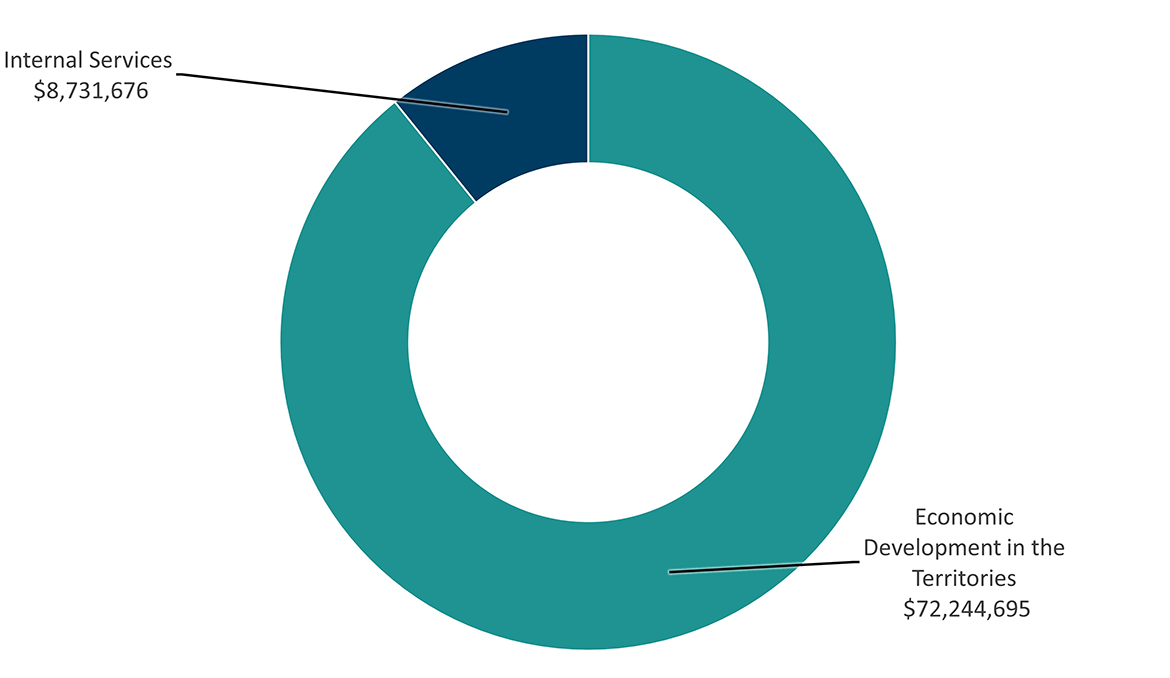
Text alternative for Graph 1 Actual spending by core responsibility in 2024-25
| Core responsibilities and internal services | 2024-25 actual spending |
|---|---|
| Economic Development in the Territories | $72,244,695 |
| Internal Services | $8,731,676 |
* Internal services spending is reflective of CanNor's status as a small agency and the costs associated with working and being headquartered in the North (e.g., northern isolated post allowances for employees).
Analysis of actual spending by core responsibility
The variance between actual and planned spending (13.4%) is due to the inclusion of additional in-year funding.
Refocusing Government Spending
In Budget 2023, the government committed to reducing spending by $14.1 billion over five years, starting in 2023-24, and by $4.1 billion annually after that.
As part of meeting this commitment, CanNor identified the following spending reductions.
- 2024-25: $308,480
- 2025-26: $480,000
- 2026-27: $714,560
During 2024-25, CanNor worked to realize these reductions by reducing outside professional services and prioritizing the expertise of internal staff.
Budgetary performance summary
Table 5: Actual three-year spending on core responsibilities and internal services (dollars)
Table 5 shows the money that CanNor spent in each of the past three FYs on its core responsibilities and on internal services.
| Core responsibilities and internal services | 2024–25 Main Estimates | 2024–25 total authorities available for use | Actual spending over three years (authorities used) |
|---|---|---|---|
| Economic Development in the Territories | $62,922,241 | $71,757,135 |
|
| Internal services | $8,465,735 | $9,590,410 |
|
| Total | $71,387,976 | $81,347,545 |
|
Analysis of the past three years of spending
The variance between the 2024-25 Main Estimates and the total available authorities for use is due to the inclusion of additional in-year funding. The variance between total authorities available and total authorities used in 2024-25 for Economic Development in the Territories is the result of the Agency transferring authorities from Internal Services to Core Responsibilities spending. The year-over-year fluctuations in actual spending reflect the dynamic nature of the Agency's operations and the need to adapt to evolving circumstances in the North due to shifts in program priorities, changes in project timelines, and variations in funding availability.
The Finances section of the Infographic for CanNor on GC Infobase offers more financial information from previous years.
Table 6: Planned three-year spending on core responsibilities and internal services (dollars)
Table 6 shows CanNor's planned spending for each of the next three years on its core responsibilities.
| Core responsibilities and internal services | 2025–26 planned spending | 2026–27 planned spending | 2027–28 planned spending |
|---|---|---|---|
| Economic Development in the Territories | $58,362,614 | $54,490,924 | $39,514,979 |
| Internal services | $7,958,538 | $7,268,107 | $5,270,586 |
| Total | $66,321,152 | $61,759,031 | $44,785,565 |
Analysis of the next three years of spending
Total planned spending includes only the main estimates for FYs 2025-26 to 2027-28. The decrease in funding from 2025-26 onward reflects the sunsetting of a variety of time-limited, short-term initiatives, such as the Tourism Growth Program. Important reductions are further anticipated in 2027-28 with the sunsetting of the Regional Economic Growth Through Innovation program and IDEANorth top-up funding. Sunsetting funds, at the discretion of the Government, may be renewed, increased or cancelled.
The Finances section of the Infographic for CanNor on GC Infobase offers more detailed financial information related to future years.
Funding
This section provides an overview of the department's voted and statutory funding for its core responsibilities and for internal services. Consult the Government of Canada budgets and expenditures for further information on funding authorities.
Graph 2: Approved funding (statutory and voted) over a six-year period
Graph 2 summarizes the department's approved voted and statutory funding from 2022-23 to 2027-28.
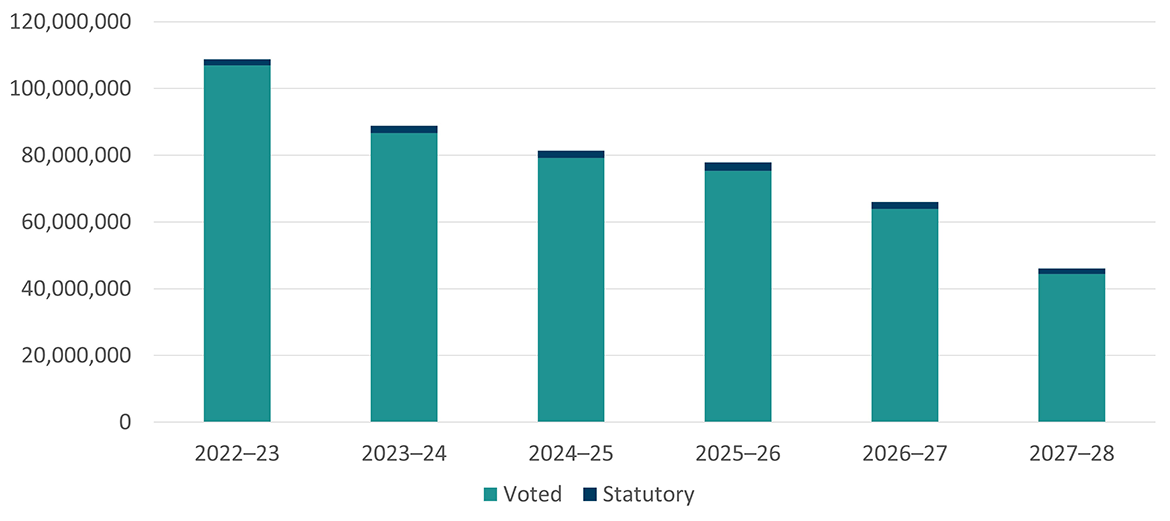
Text alternative for Graph 2: Approved funding (statutory and voted) over a six-year period
| Fiscal year | Statutory | Voted | Total |
|---|---|---|---|
| 2022-23 | $1,861,614 | $106,879,403 | $108,741,017 |
| 2023-24 | $2,140,214 | $86,653,451 | $88,793,665 |
| 2024-25 | $2,223,485 | $79,155,065 | $81,378,550 |
| 2025-26 | $2,496,199 | $75,338,841 | $77,835,040 |
| 2026-27 | $2,137,801 | $63,886,308 | $66,024,109 |
| 2027-28 | $1,677,682 | $44,430,729 | $46,108,411 |
Analysis of statutory and voted funding over a six-year period
As shown above, the total funding for FYs 2022-23, 2023-24 and 2024-25 include all parliamentary appropriation sources, such as the 'Main Estimates', 'Supplementary Estimates', and funding from various Treasury Board votes. For FYs 2025-26 to 2027-28, total planned funding does not include 'Supplementary Estimates' or any future Treasury Board submissions. The decrease in funding from FY 2025-26 onward reflects the sunsetting of a variety of time-limited, short-term initiatives, such as the Tourism Growth Program. Further reductions are anticipated in FY 2027-28 with the sunsetting of the Regional Economic Growth Through Innovation program and IDEANorth top-up funding. Finally, the year-over-year fluctuations in actual and planned funding highlight the dynamic nature of the Agency's operations and the need to adapt to changing circumstances in the North. These variances are caused by shifting program priorities, adjustments in project timelines, and variations in funding availability.
Consult the Public Accounts of Canada for further information on CanNor's departmental voted and statutory expenditures.
Financial statement highlights
Please see the CanNor's Financial Statements (Audited/Unaudited) for the Year Ended March 31, 2025.
Table 7: Condensed Statement of Operations (unaudited or audited) for the year ended March 31, 2025 (dollars)
Table 7 summarizes the expenses and revenues for 2024-25 which net to the cost of operations before government funding and transfers.
| Financial information | 2024–25 actual results | 2024–25 planned results | Difference (actual results minus planned) |
|---|---|---|---|
| Total expenses | 74,067,405 | 64,628,679 | 9,438,726 |
| Total revenues | 64 | 40,580 | (40,516) |
| Net cost of operations before government funding and transfers | 74,067,341 | 64,588,099 | 9,479,242 |
Analysis of expenses and revenues for 2024-25
There is a difference in actual results compared to planned results for total expenses because the 2024-25 planned results were based on Main Estimates. Subsequently, CanNor received additional spending authorities via Supplementary Estimates (B). For total revenues, the planned results were based on a forecast that did not materialize.
The 2024–25 planned results information is provided in CanNor's Future-Oriented Statement of Operations and Notes 2024-25.
Table 8: Condensed Statement of Operations (unaudited) for 2023-24 and 2024-25 (dollars)
Table 8 summarizes actual expenses and revenues and shows the net cost of operations before government funding and transfers.
| Financial information | 2024–25 actual results | 2023–24 actual results | Difference (2024-25 minus 2023-24) |
|---|---|---|---|
| Total expenses | 74,067,405 | 68,475,875 | 5,591,530 |
| Total revenues | 64 | 6 | 58 |
| Net cost of operations before government funding and transfers | 74,067,341 | 68,475,869 | 5,591,472 |
Analysis of differences in expenses and revenues between 2023-24 and 2024-25
There is a difference between 2024-25 actual results and 2023-24 actual results largely because CanNor received new additional authorities via Supplementary Estimates (B) in fiscal year 2024-25.
Table 9: Condensed Statement of Financial Position (unaudited) as of March 31, 2025 (dollars)
Table 9 provides a brief snapshot of the amounts the department owes or must spend (liabilities) and its available resources (assets), which helps to indicate its ability to carry out programs and services.
| Financial information | Actual fiscal year (2024–25) | Previous fiscal year (2023–24) | Difference (2024–25 minus 2023–24) |
|---|---|---|---|
| Total net liabilities | 42,767,935 | 44,706,657 | (1,938,722) |
| Total net financial assets | 45,706,033 | 43,471,252 | 2,234,781 |
| Departmental net debt | 1,317,865 | 1,235,405 | 82,460 |
| Total non-financial assets | 536,093 | 548,366 | (12,273) |
| Departmental net financial position | (781,772) | (687,039) | (94,733) |
Analysis of department’s liabilities and assets since last fiscal year
There have been no significant changes in the liabilities and assets since the last FY. Total net liabilities decreased slightly because of a drop in accounts payable and accrued liabilities. Total net financial assets decreased slightly because accounts receivable increased resulting in a decrease in the amount due for the Consolidated Revenue Fund, and loans receivable decreased.
Human resources
This section presents an overview of the department's actual and planned human resources from FY 2022–23 to FY 2027–28.
Table 10: Actual human resources for core responsibilities and internal services
Table 10 shows a summary in full-time equivalents of human resources for CanNor's core responsibilities and for its internal services for the previous three FYs.
| Core responsibilities and internal services | 2022–23 actual full-time equivalents | 2023–24 actual full-time equivalents | 2024–25 actual full-time equivalents |
|---|---|---|---|
| Economic Development in the Territories | 80 | 83 | 86 |
| Internal services | 32 | 33 | 30 |
| Total | 112 | 116 | 116 |
Analysis of human resources for the last three years
The year-over-year changes in actual full-time equivalents (FTEs) are mainly due to staff turnover.
Table 11: Human resources planning summary for core responsibilities and internal services
Table 11 shows the planned FTEs for each of CanNor's core responsibilities and for its internal services for the next three FYs. Human resources for the current FY are forecast based on year to date.
| Core responsibilities and internal services | 2025–26 planned full-time equivalents | 2026–27 planned full-time equivalents | 2027–28 planned full-time equivalents |
|---|---|---|---|
| Economic Development in the Territories | 93 | 92 | 76 |
| Internal services | 31 | 31 | 31 |
| Total | 124 | 123 | 107 |
Analysis of human resources for the next three years
The planned FTEs are stabilized for the next two years based on Budget 2023's renewal of CanNor's flagship program IDEANorth, before decreasing in 2027-28 by 16 FTEs due to sunsetting funds associated with the program. Sunsetting funds, at the discretion of the Government, may be renewed, increased or cancelled.
Supplementary information tables
The following supplementary information tables are available on CanNor's website:
- Details on transfer payment programs
- Up-front multi-year funding
- Gender-based Analysis Plus
- Response to Parliamentary committees and external audits
Federal tax expenditures
The tax system can be used to achieve public policy objectives through the application of special measures such as low tax rates, exemptions, deductions, deferrals and credits. The Department of Finance Canada publishes cost estimates and projections for these measures each year in the Report on Federal Tax Expenditures. This report also provides detailed background information on tax expenditures, including descriptions, objectives, historical information and references to related federal spending programs, as well as evaluations and GBA Plus analyses of tax expenditures.
Corporate information
Departmental profile
Appropriate minister(s): The Honourable Rebecca Chartrand, Minister of Northern and Arctic Affairs and Minister responsible for the Canadian Northern Economic Development Agency
Institutional head: Jimi Onalik, President
Ministerial portfolio: Canadian Northern Economic Development Agency
Enabling instrument(s): Public Service Rearrangement and Transfer of Duties Act, R.S.C. 1985, c. P-34
Year of incorporation / commencement: 2009
Departmental contact information
Mailing address:
200 – 1106 Iqaluktuutiak Drive,
Iqaluit, Nunavut, X0A 3H0, Canada
Telephone: 1-855-897-2667
Email: infonorth-infonord@cannor.gc.ca
Website(s): Canadian Northern Economic Development Agency Website
Definitions
- appropriation (crédit)
- Any authority of Parliament to pay money out of the Consolidated Revenue Fund.
- budgetary expenditures (dépenses budgétaires)
- Operating and capital expenditures; transfer payments to other levels of government, departments or individuals; and payments to Crown corporations.
- core responsibility (responsabilité essentielle)
- An enduring function or role of a department. The departmental results listed for a core responsibility reflect the outcomes that the department seeks to influence or achieve.
- Departmental Plan (plan ministériel)
- A report that outlines the anticipated activities and expected performance of an appropriate department over a 3-year period. Departmental Plans are usually tabled in Parliament in spring.
- departmental priority (priorité)
- A plan, project or activity that a department focuses and reports on during a specific planning period. Priorities represent the most important things to be done or those to be addressed first to help achieve the desired departmental results.
- departmental result (résultat ministériel)
- A high-level outcome related to the core responsibilities of a department.
- departmental result indicator (indicateur de résultat ministériel)
- A quantitative or qualitative measure that assesses progress toward a departmental result.
- departmental results framework (cadre ministériel des résultats)
- A framework that connects the department's core responsibilities to its departmental results and departmental result indicators.
- Departmental Results Report (rapport sur les résultats ministériels)
- A report outlining a department's accomplishments against the plans, priorities and expected results set out in the corresponding Departmental Plan.
- Full-time equivalent (équivalent temps plein)
- Measures the person years in a departmental budget. An employee's scheduled hours per week divided by the employer's hours for a full-time workweek calculates a full-time equivalent. For example, an employee who works 20 hours in a 40-hour standard workweek represents a 0.5 full-time equivalent.
- Gender-based Analysis Plus (GBA Plus) (analyse comparative entre les sexes plus [ACS Plus])
- An analytical tool that helps to understand the ways diverse individuals experience policies, programs and other initiatives. Applying GBA Plus to policies, programs and other initiatives helps to identify the different needs of the people affected, the ways to be more responsive and inclusive, and the methods to anticipate and mitigate potential barriers to accessing or benefitting from the initiative. GBA Plus goes beyond biological (sex) and socio-cultural (gender) differences to consider other factors, such as age, disability, education, ethnicity, economic status, geography (including rurality), language, race, religion, and sexual orientation.
- government priorities (priorités pangouvernementales)
- For the purpose of the 2024–25 Departmental Results Report, government priorities are the high-level themes outlining the government's agenda as announced in the 2021 Speech from the Throne.
- horizontal initiative (initiative horizontale)
- A program, project or other initiative where two or more federal departments receive funding to work collaboratively on a shared outcome usually linked to a government priority, and where the ministers involved agree to designate it as horizontal. Specific reporting requirements apply, including that the lead department must report on combined expenditures and results.
- Indigenous business (entreprise autochtones)
- For the purposes of a Departmental Result Report, this includes any entity that meets the Indigenous Services Canada's criteria of being owned and operated by Elders, band and tribal councils, registered in the Indigenous Business Directory or registered on a modern treaty beneficiary business list.
- non budgetary expenditures (dépenses non budgétaires)
- Net outlays and receipts related to loans, investments and advances, which change the composition of the financial assets of the Government of Canada.
- performance (rendement)
- What a department did with its resources to achieve its results, how well those results compare to what the department intended to achieve, and how well lessons learned have been identified.
- performance indicator (indicateur de rendement)
- A qualitative or quantitative measure that assesses progress toward a departmental-level or program-level result, or the expected outputs or outcomes of a program, policy or initiative.
- plan (plan)
- The articulation of strategic choices, which provides information on how a department intends to achieve its priorities and associated results. Generally, a plan will explain the logic behind the strategies chosen and tend to focus on actions that lead to the expected result.
- planned spending (dépenses prévues)
- For Departmental Plans and Departmental Results Reports, planned spending refers to the amounts presented in Main Estimates. Departments must determine their planned spending and be able to defend the financial numbers presented in their Departmental Plans and Departmental Results Reports.
- program (programme)
- An Individual, group, or combination of services and activities managed together within a department and focused on a specific set of outputs, outcomes or service levels.
- program inventory (répertoire des programmes)
- A listing that identifies all the department's programs and the resources that contribute to delivering on the department's core responsibilities and achieving its results.
- result (résultat)
- An outcome or output related to the activities of a department, policy, program or initiative.
- statutory expenditures (dépenses législatives)
- Spending approved through legislation passed in Parliament, other than appropriation acts. The legislation sets out the purpose and the terms and conditions of the expenditures.
- target (cible)
- A quantitative or qualitative, measurable goal that a department, program or initiative plans to achieve within a specified time period.
- voted expenditures (dépenses votées)
- Spending approved annually through an appropriation act passed in Parliament. The vote also outlines the conditions that govern the spending.