Canadian Northern Economic Development Agency's 2026-27 Departmental plan
PDF Version (725 Kilobyte, 31 pages)
On this page
Copyright information
© His Majesty the King in Right of Canada, as represented by the Minister of Arctic Affairs and Minister Responsible for the Canadian Northern Economic Development Agency, 2026
ISSN 2371-7564
At a glance
This departmental plan details the Canadian Northern Economic Development Agency's (CanNor) priorities, plans, and associated costs for the upcoming three fiscal years. It details how CanNor will use its financial and human resources to advance sustainable, diversified, and resilient territorial economies, consistent with CanNor's role as the Government of Canada's regional development agency for the North.
These plans align with the priorities outlined in the Mandate Letter, as well as CanNor's Vision, mission, raison d'être and operating context.
Key priorities
In 2026-27, CanNor will sharpen its focus on removing structural barriers that limit long-term growth, while continuing to deliver core supports for businesses, communities, and Indigenous partners across the territories. These priorities reinforce CanNor's core mandate: supporting business development, community capacity, economic diversification, and advocacy for territorial priorities within federal decision-making, ensuring public investments generate durable economic opportunity for Northerners.
CanNor has identified the following key priorities for 2026-27:
- Strengthen project readiness and infrastructure stability: Improve readiness for major projects and infrastructure enablement by supporting governance clarity, coordinating regulatory processes, aligning capital pathways, and enabling foundational energy and infrastructure conditions that reduce structural barriers to economic growth and strengthen long-term Arctic economic resilience;
- Advance Indigenous economic participation and reconciliation: Support Indigenous governments, organizations, and businesses to increase participation and equity in economic development, strengthening Indigenous ownership, workforce readiness, and long-term community capacity. All priorities will be delivered in support of economic reconciliation, aligned with the Modern Treaty Implementation Policy, Inuit Nunangat Policy, and United Nations Declarations on the Rights of Indigenous Peoples Act (UNDA) commitments, as well as Article 23 of the Nunavut Agreement (PDF) and Chapter 22 under the Umbrella Final Agreement in the Yukon;
- Align capital and strengthen northern supply chains, including food systems: Coordinate federal funding, private investment, and territorial partnerships to strengthen construction, clean energy, transportation, innovation ecosystems, and resilient northern supply chains. This includes strengthening northern food systems by supporting Indigenous and northern entrepreneurs across food production, fisheries, and harvesting value chains, processing and preparation capacity, and logistics to build local capacity and improve long-term affordability; and
- Improve regulatory coordination and crown consultation: Through the Northern Projects Management Office (NPMO), strengthen federal coordination in regulatory processes and Crown consultation to improve predictability, timeliness, integrity, and successful implementation, while upholding treaty obligations and environmental stewardship.
Comprehensive Expenditure Review
The Government of Canada is committed to restraining the growth of day-to-day operational spending to make investments that will grow the economy and benefit Canadians.
In support of this commitment, CanNor will implement the following spending reductions:
- 2026-27: $6,334,480
- 2027-28: $9,276,569
- 2028-29: $11,300,997
By 2028-29, these reductions will include a decrease of approximately $727,000 in salary expenditures.
CanNor will achieve these reductions by:
- Winding down the Tourism Growth Program after 2025-26, with continued sector support delivered through core programming;
- Winding down the Northern Isolated Community Initiatives (NICI) Program after 2026-27, with continued support to industry and communities through existing program authorities; and
- Managing workforce adjustments through attrition, with vacant core-funded positions not replaced.
The figures in this departmental plan reflect these reductions.
This illustrates a deliberate shift toward concentrating resources on high-impact economic development priorities, including project readiness, Indigenous economic participation, regulatory coordination, and northern supply chain resilience. Within this streamlined fiscal framework, CanNor will continue to deliver its core mandate while strengthening discipline in program alignment, investment sequencing, and measurable economic outcomes.
Highlights for CanNor in 2026-27
In 2026-27, CanNor will deploy existing core programming architecture and new "strategic initiatives" that are time-limited and targeted in a disciplined and coordinated manner to strengthen northern infrastructure readiness, economic resilience, innovation capacity, and Indigenous participation aligned with national economic, affordability, and Arctic sovereignty priorities.
In 2026-27, CanNor will deliver several new funding streams:
- Economic stabilization and business resilience
- Regional Tariff Response Initiative (RTRI): Support for territorial businesses and organizations affected by tariffs and global trade disruptions, strengthening resilience against external economic shocks and protecting northern supply chains.
- Black Entrepreneurship Program (BEP): Support for northern organizations in delivering advisory services, mentorship, incubator and accelerator programming, and financial planning services to Black entrepreneurs, expanding inclusive business participation.
- Structural readiness and infrastructure enablement
- Support for Northern Infrastructure Development (SNID): Strengthen Indigenous and northern capacity and pre-assessment alignment for Arctic Infrastructure Fund (AIF) (and other major northern projects). SNID will advance proponent readiness, regulatory coordination, and early-stage development aligned with territorial economic priorities.
- Regional Defence Investment Initiative (RDII): Support territorial businesses looking to integrate into domestic and international defence supply chains, strengthening Arctic readiness, economic security, and northern industrial participation in dual-use infrastructure and sovereignty-related investments.
- Innovation and productivity growth
- Regional Artificial Intelligence Initiative (RAII): Support adoption of advanced technologies, including artificial intelligence and digital solutions, to improve productivity, competitiveness, and innovation across territorial economies.
- Workforce and institutional capacity
- New Pilimmaksaivik programming (Nunavut) will expand access to culturally relevant, community-based learning for Nunavut Inuit through partnerships with Nunavut-based training institutions and Inuit organizations, strengthening long-term labour force and institutional capacity.
In 2026-27, CanNor will also deliver its core programming through:
- Investing in dynamic, resilient and growing territorial economies through its unique Inclusive Diversification and Economic Advancement in the North (IDEANorth) and Northern Indigenous Economic Opportunities Program (NIEOP) funding programs. These programs support business scale-up, community capacity, sector diversification, and Indigenous economic participation across the territories.
- The Northern Projects Management Office (NPMO) will strengthen project readiness and federal regulatory coordination to improve clarity, predictability, and Indigenous participation in major infrastructure and resource development initiatives.
- Pilimmaksaivik: Federal Centre of Excellence for Inuit Employment in Nunavut will advance the Whole-of-Government Inuit Employment Plan and support implementation of Article 23 through targeted recruitment, training, and pre-employment programming.
In 2026-27, total approved planned spending (including internal services) for CanNor is $114,839,371 with 128 full-time equivalents supporting program delivery.
Summary of planned results
The following provides a summary of the results the department plans to achieve in 2026-27 under its main areas of activity, called "core responsibilities."
-
Core responsibility 1: Economic Development in the Territories
In 2026-27, CanNor will strengthen sustainable and diversified territorial economies by directing its funding, policy advocacy, and project readiness efforts toward high-impact initiatives that address structural barriers to growth. The Agency will prioritize foundational infrastructure stability, Indigenous economic participation, and capital alignment in sectors critical to long-term resilience, including responsible resource development, clean energy, strategic infrastructure, northern food systems, fisheries, housing innovation, and knowledge-driven industries.
CanNor will also support small and medium-sized enterprises (SMEs) in improving productivity, innovation, and competitiveness, including through the adoption of digital and advanced technologies.
- Support federal mandate priorities by advancing strategically sequenced initiatives that strengthen sovereignty, affordability, and long-term economic resilience;
- Improve project readiness by enhancing governance clarity, capital alignment, and regulatory coordination for major infrastructure (including housing) and resource development projects;
- Strengthen local and regional economic benefits through resilient northern supply chains and increased Indigenous participation;
- Advocate for territorial economic development priorities in collaboration with Indigenous governments, territorial partners, and industry;
- Uphold consultation obligations for major projects and support sustainable development in regulatory and impact assessment processes; and
- Advance economic reconciliation by strengthening Indigenous equity participation, workforce readiness, and community capacity.
Approved planned spending: $106,881,378
Planned human resources to deliver on core responsibilities: 96 FTEs
More information about Economic Development in the Territories can be found in the full plan.
For complete information on CanNor's total planned spending and human resources, read the Planned spending and human resources section of the full plan.
From the Minister
I am pleased to present the Canadian Northern Economic Development Agency (CanNor) 2026-2027 Departmental Plan. Canada is facing heightened economic and geopolitical pressures, and our government has been entrusted with delivering results with urgency and discipline. In this context, the North is not a distant frontier; it is central to Canada's security, economic resilience, and long-term prosperity. The territories sit at the heart of Arctic sovereignty, climate resilience, and nation-building. As Canada's regional development agency for the North, CanNor plays a critical role in strengthening the economic foundations that support Canada's presence and preparedness in this pivotal region.
In 2026-2027, CanNor will concentrate its efforts on initiatives that remove structural barriers to growth. We will prioritize project readiness, foundational energy and infrastructure stability, and Indigenous economic participation to ensure that major initiatives advance with clearer governance, defined capital pathways, and coordinated regulatory processes.
We will support critical and dual-use infrastructure and trade-enabling corridors, including projects such as the Iqaluit Nukkittsautiit hydroelectric project. We will advance strategic sectors such as critical minerals and clean energy, while strengthening the capacity of northern businesses and communities to participate in emerging infrastructure and defence-related opportunities. Through targeted programming, including the Regional Defence Investment Initiative (RDII), we are reinforcing northern participation in Canada's evolving economic and security landscape.
We will also strengthen northern food systems by supporting local production, fisheries and harvesting value chains, processing capacity, and regional supply chains. By building economic capacity alongside affordability measures, we are working to improve long-term food security and reduce structural reliance on imported systems.
Across all priorities, CanNor will apply disciplined investment decisions, strengthened coordination, and responsible stewardship of public funds. Working closely with Indigenous governments, territorial partners, businesses, and communities, we are advancing diversified territorial economies led by Northerners themselves, contributing to a Canadian economy that is secure, resilient, and inclusive.

The Honourable Rebecca Chartrand
Minister of Northern and Arctic Affairs, and Minister responsible for the Canadian Northern Economic Development Agency.
Plans to deliver on core responsibilities and internal services
Core responsibilities and internal services
Core responsibility 1: Economic Development in the Territories
In this section
Description
Working in the three territories to support the conditions for a sustainable, diversified, and innovative economy in collaboration with Northerners/Indigenous people, businesses, organizations, other federal departments and other levels of government.
Quality of life impacts
- This core responsibility contributes to the "Prosperity" domain of the Quality of Life Framework for Canada, particularly through impacts on "Gross Domestic Product per Capita", "Productivity", "Employment", and "Firm Dynamism" indicators across the territories.
Indicators, results and targets
This section presents details on the department's indicators, the actual results from the three most recently reported fiscal years, and the targets and target dates for Economic Development in the Territories. Details are presented by departmental result.
Table 1.1: People and communities participate in the economy in the territories
Table 1.1 shows CanNor's performance indicators over time for northern projects, with recent results compared against fiscal year 2026-2027 targets and deadlines.
| Departmental Result Indicators | Actual Results | 2026–27 Target | Date to achieve target |
|---|---|---|---|
| Total number of northern communities reached by CanNor funded projectsTable note 1 |
|
39 | March 2027 |
| Amount of additional support from external sources per dollar invested by CanNor in projects |
|
1.35 | March 2027 |
|
|||
Table 1.2: Businesses are innovative and growing in the territories
Table 1.2 shows business performance indicators over time, comparing recent results on revenue growth and inclusivity against fiscal year 2026-27 targets and deadlines.
| Departmental Result Indicators | Actual Results | 2026–27 Target | Date to achieve target |
|---|---|---|---|
| Revenue growth rate of firms supported by CanNor programs |
|
2.3% | March 2027 |
| Percentage of firms supported by CanNor programs that are led or owned by underrepresented groups |
|
51.5% | March 2027 |
Table 1.3: Efficient and predictable environmental review process in the territories
Table 1.3 summarizes service and participation indicators, comparing recent NPMO support levels and Indigenous engagement to fiscal year 2026-27 targets and deadlines.
| Departmental Result Indicators | Actual Results | 2026–27 Target | Date to achieve target |
|---|---|---|---|
| Number of pathfinding and convening services provided by Northern Projects Management Office (NPMO). |
|
75 | March 2027 |
| Percentage of identified Indigenous governments and/or organizations that receive support to participate in northern regulatory processes. |
|
75% | March 2027 |
Table 1.4: Increasing Inuit representation in the federal public service within Nunavut Settlement Area
Table 1.4 shows annual counts of Pilimmaksaivik in-service programs from fiscal year 2022-23 to 2024-25, alongside the 2026-27 target and deadline.
| Departmental Result Indicators | Actual Results | 2026–27 Target | Date to achieve target |
|---|---|---|---|
| Number of Pilimmaksaivik coordinated or delivered in-service programs and services per year. |
|
10 | March 2027 |
Additional information on the detailed results and performance information for CanNor's program inventory is available on GC InfoBase.
Plans to achieve results
The following section describes the planned results for Economic Development in the Territories in fiscal year 2026-27, with a focus on project readiness, Indigenous economic participation, and strengthening regional supply chains.
People and communities participate in the economy of the territories
CanNor programming supports northern communities, many of which are small and remote, by strengthening the conditions required for sustainable economic growth and long-term resilience.
In fiscal year 2026-27, CanNor will continue to work directly with Indigenous Peoples, communities, and businesses through the Northern Indigenous Economic Opportunities Program (NIEOP) to advance employment, income generation, and wealth creation, including opportunities linked to major infrastructure development, supply chain expansion, and sectoral diversification.
The Agency will also collaborate with other Regional Development Agencies (RDAs), territorial stakeholders, and First Nations, Inuit, and Métis partners to strengthen northern food systems by expanding local production, innovation, and regional supply chain capacity.
Results we plan to achieve
- Increase community economic development capacity and employment by enhancing opportunities for jobs, income, and wealth creation. CanNor will leverage the Community Readiness and Opportunities Planning (CROP) fund, a sub-stream of NIEOP to support governance clarity, planning capacity, and infrastructure readiness.
- Provide targeted, project-based support to First Nations, Inuit, and Métis entrepreneurs, businesses, and organizations under NIEOP's Entrepreneurship and Business Development Program (EBD) to establish, scale, and sustain businesses, with a focus on strengthening Indigenous ownership and participation in emerging sectors.
- Address knowledge gaps in the territorial Indigenous economic ecosystem by promoting Indigenous-led research and knowledge mobilization under NIEOP's Economic Research Stream (ERS) to support evidence-based decision-making
- Through the Northern Isolated Community Initiatives (NICI) Fund, CanNor will strengthen northern food systems by supporting local production, fisheries and harvesting value chains, processing and preparation capacity, and regional supply chains. These investments will complement affordability measures by building long-term economic capacity and reducing structural reliance on imported food systems.
Businesses are innovative and growing in the territories
CanNor supports the start-up, growth, and expansion of northern businesses, including small- and medium-sized enterprises (SMEs), through targeted grants and contributions that build capacity, improve productivity, and position firms to participate in high-impact economic opportunities. The objective is to foster a northern business ecosystem that is competitive, resilient, and strategically integrated into major infrastructure, energy, defence, and regional supply chains.
In fiscal year 2026-27, CanNor will focus support on businesses operating in priority areas such as critical minerals and responsible resource development, Arctic sovereignty and defence, clean energy and infrastructure, housing innovation, fisheries and northern food systems, digital adoption and productivity growth, research, workforce development, and arts and cultural industries.
Aligned with the federal government's focus on Arctic security, nation building infrastructure, and domestic supply chain resilience, CanNor will work to increase northern and Indigenous participation in major projects, including dual-use infrastructure and defence-related initiatives, while strengthening regional production, processing, and distribution capacity in strategic sectors.
CanNor's annual Expression of Interest (EOI) process for the 2026-27 fiscal year will continue to identify and prioritize projects aligned with these objectives. Where appropriate, the Agency will use targeted outreach and flexible intake approaches to respond to emerging opportunities and accelerate high-impact initiatives.
Results we plan to achieve
- Support business scale-up, productivity improvements, and economic infrastructure development through IDEANorth, with a focus on projects that strengthen regional supply chains and long-term competitiveness.
- Enhance business resilience and market diversification through the Regional Tariff Response Initiative (RTRI), supporting cost-reduction measures, productivity improvements, and domestic supply chain development.
- Strengthen the territorial contribution to Canada's defence industrial base through the Regional Defence Investment Initiative (RDII), supporting innovation ecosystems, dual-use technologies, and increased northern participation in defence supply chains.
- Strengthen northern food systems by supporting local production, fisheries and harvesting value chains, processing capacity, and regional market access, positioning northern businesses to contribute to long-term food security and affordability.
Efficient and predictable environmental review process in the territories
The Northern Projects Management Office (NPMO) plays a central role in strengthening regulatory clarity, project sequencing, and Crown consultation for major resource, clean growth, and infrastructure projects in the territories.
Working with Indigenous governments and organizations, territorial governments, industry, regulatory boards, and federal departments, NPMO supports coordinated, transparent, and timely federal participation in environmental impact assessments and regulatory processes. By improving clarity and predictability, NPMO helps reduce structural uncertainty, strengthens investor confidence, and advances projects that contribute to northern economic resilience and Arctic sovereignty.
In fiscal year 2026-27, NPMO will continue its regulatory pathfinding role while expanding coordination responsibilities under the 2024 Cabinet Directive on Regulatory and Permitting Efficiency for Clean Growth Projects. To further enhance project readiness, NPMO will strengthen upstream engagement and sequencing functions, including expanded pre-consultation support, and improved coordination across departments, ensuring that major projects advance in an orderly, consultation-informed, and capital-aligned manner.
Results we plan to achieve
- Support federal decision-makers in fulfilling their Duty to Consult with Indigenous Peoples, while improving clarity and coordination in regulatory processes for major projects.
- Oversee and coordinate Crown consultations for at least 19 major projects, including the Grays Bay Road and Port (Arctic Economic and Security Corridor), the Mackenzie Valley Highway, and the Casino Mine Project.
- Advance implementation of the Cabinet Directive on Regulatory and Permitting Efficiency for Clean Growth Projects, including enhanced coordination and tracking to support the Deputy Ministers' Regulatory Efficiency Action Council.
- For projects funded under the Arctic Infrastructure Fund (AIF), and those aligned with AIF priorities:
- Strengthen pre-assessment consultation readiness and Indigenous participation supports;
- Convene federal, territorial, and Indigenous partners to improve sequencing and reduce process redundancies; and
- Enhance post-assessment coordination to support successful regulatory implementation.
Increasing Inuit representation in the federal public service within Nunavut Settlement Area
CanNor hosts Pilimmaksaivik, the Federal Centre of Excellence for Inuit Employment in Nunavut, which advances a whole-of-government approach to strengthening Inuit representation in the federal public service within the Nunavut Settlement Area, in fulfillment of Article 23 of the Nunavut Agreement.
In fiscal year 2026-27, Pilimmaksaivik will continue to reduce systemic barriers to recruitment and retention by delivering culturally-grounded training and working to expand wrap-around supports that seek to enable employment success. Pilimmaksaivik will advance implementation of the 2023-2033 Whole-of-Government Inuit Employment Plan and launch a new pre-employment funding program to support community-driven training initiatives aligned with federal workforce needs. These initiatives will be delivered through Pilimmaksaivik's new public-facing office, designed to improve accessibility, outreach, and coordination.
Results we plan to achieve
- Strengthen whole-of-government coordination to improve recruitment, training, and retention of Nunavut Inuit in federal positions.
- Support federal departments in implementing, monitoring, and reporting on Inuit Employment Plans and Pre-Employment Training planning and implementation to ensure measurable progress under Article 23.
- Expand culturally-grounded pre-employment and in-service programming for Nunavut Inuit, including language training and professional development pathways.
- Enhance employee wellness, mentorship, and peer support systems, including through the Kittuaq Inuit Employees Network.
- Improve outreach and awareness to position the federal public service as an accessible and culturally responsive employer in Nunavut.
Gender-based Analysis Plus
CanNor integrates Gender-based Analysis Plus (GBA+) into the design, delivery, and evaluation of its economic development programming to ensure that investments address structural barriers and promote inclusive participation across the territories. Programs such as IDEANorth and the NIEOP support participation by youth, women, 2SLGBTQIA+ individuals, persons with disabilities, First Nations, Inuit, and Métis entrepreneurs and communities. Funding decisions consider regional labour dynamics, access to capital, geographic isolation, and sector-specific barriers to ensure that economic growth opportunities are accessible and equitable. Through Pilimmaksaivik, CanNor advances Article 23 of the Nunavut Agreement, contributing to increased Inuit representation within the federal public service in the Nunavut Settlement Area and strengthening institutional capacity in the territory.
In 2026-27, CanNor will continue to apply an intersectional lens in program delivery, monitoring, and reporting. The Agency's GBA+ champions and the internal Community of Practice will support the integration of inclusive approaches into policy development, funding assessments, and performance measurement.
Planned resources to achieve results
Table 2: Planned resources to achieve results for Economic Development in the Territories
Table 2 provides a summary of the approved planned spending and full-time equivalents required to achieve results.
| Resource | Planned |
|---|---|
| Spending | $106,881,378 |
| Full-time equivalents | 96 FTEs |
Complete financial and human resources information for CanNor's program inventory is available on GC InfoBase.
Program inventory
Economic Development in the Territories is supported by the following programs:
- Community Development
- Business development
- Policy and Advocacy
- Northern Projects Management Office
- Pilimmaksaivik
Additional information related to the program inventory for Economic Development in the Territories is available on the Results page on GC InfoBase.
Summary of changes to reporting framework since last year
- All ministers received a unified mandate letter from the Prime Minister rather than individualized letters, ensuring a shared vision and consistent priorities across government.
- Changed the indicators for the departmental results People and Communities Participate in the Economy of the Territories.
- Changed the indicators for the departmental result Businesses Are Developing in the Territories.
- Changed the indicators for the departmental result Efficient and Predictable Environmental Review Process in the territories.
- Added a new departmental result: Increasing Inuit Representation in the Federal Public Service within Nunavut Settlement Area, along with a new corresponding departmental result indicator for this departmental result.
- Added a new program, Pilimmaksaivik, along with corresponding program outcome and program result indicator.
Internal services
In this section
Description
Internal services are the services that are provided within a department so that it can meet its corporate obligations and deliver its programs across three northern office locations (Iqaluit, Yellowknife, and Whitehorse) and the Ottawa Liaison Office. There are 10 categories of internal services:
- acquisition management services
- communications services
- financial management services
- human resources management services
- information management services
- information technology services
- legal services
- material management services
- management and oversight services
- real property management services
Plans to achieve results
This section details the Agency's plans to achieve results and meet targets for internal services.
In fiscal year 2026-27, CanNor plans to continue, or undertake, the following:
- Deliver dedicated client services and refine business processes to remain responsive to evolving governmental and departmental objectives.
- Implement initiatives across CanNor aimed at enhancing fiscal prudence and responsible financial management while supporting Budget 2025's focus on spending less on government operations.
- Foster a healthy, diverse and innovative work environment through initiatives such as CanNor's Diversity and Inclusion Strategy, Accessibility Plan, Inuit Employment Plan, and continue efforts to implement Article 23 of the Nunavut Agreement and the Yukon Representative Public Service Plan.
- Enhance IM/IT Service Delivery with partners by adopting new initiatives and refreshing the Agency's IM/IT governance and policy suites.
- Improve the safety, security, and operational efficiency of administrative services to support service delivery, minimize risks, and protect both public service personnel and sensitive information.
- Connect communities, entrepreneurs, and innovators across the territories with economic opportunities by leveraging various communication tools, including CanNor's website, social media, announcements, and stakeholder engagement, to better meet their needs and enhance awareness of CanNor programs, services, and results.
- Prioritize open, accessible, and transparent communication to keep employees well-informed and engaged with key departmental and government-wide priorities and initiatives.
- Explore opportunities to enable responsible adoption of Artificial Intelligence (AI) to enhance operational efficiencies and support evidence-based decision-making.
Plans resources to achieve results
Table 3: Planned resources to achieve results for internal services this year
Table 3 provides a summary of the approved planned spending and full-time equivalents required to achieve results.
| Resource | Planned |
|---|---|
| Spending | $7,957,993 |
| Full-time equivalents | 32 FTEs |
Complete financial and human resources information for CanNor's program inventory is available on GC InfoBase.
Planning for contracts awarded to Indigenous businesses
Government of Canada departments are to meet a target of awarding at least 5% of the total value of contracts to Indigenous businesses each year. This commitment was to be fully implemented by the end of the 2024-25 fiscal year.
CanNor plans to exceed the minimum 5% target in fiscal year 2026-27.
In fiscal year 2026-27, CanNor will be outsourcing its procurement services through a Memorandum of Understanding with Prairies Economic Development Canada (PrairiesCan). In collaboration with PrairiesCan, CanNor will examine planned procurements to identify opportunities for Indigenous businesses, support their participation in competing for contract awards, and enhance oversight, planning, and reporting mechanisms specific to Indigenous procurement. CanNor will also work with PrairiesCan to ensure that reports on performance against the mandatory minimum target are approved by the department's deputy head and submitted to PrairiesCan within six months after fiscal year-end. Finally, the Agency will continue to implement measures to meet the requirements of the Directive on Government Contracts, including Real Property Leases, and to provide reasonable support to Inuit firms to help them compete for government contracts. This also includes promoting Green Procurement.
Table 4: Percentage of contracts planned and awarded to Indigenous businesses
Table 4 presents the current, actual results with forecasted and planned results for the total percentage of contracts the department awarded to Indigenous businesses.
| 5% Reporting Field | 2024-25 Actual Result | 2025-26 Forecasted Result | 2026-27 Planned Result |
|---|---|---|---|
| Total percentage of contracts with Indigenous businesses | 8.63% | A minimum of 5% at year end. | A minimum of 5% |
Department-wide considerations
In this section
Related government priorities
Policy and advocacy
The Policy and Advocacy program works to advance territorial priorities and needs in alignment with the Government of Canada's priorities and policy initiatives. In fiscal year 2026-27, CanNor will continue to build and sustain a collaborative environment with partners and clients. It will also support the federal government's mandate commitments and budget and policy priorities, further meaningful economic reconciliation efforts, advocate for and support territorial needs and priorities, support sustainable economic development, and address knowledge gaps.
Results we plan to achieve
- Participate in, and represent CanNor at, key trade shows and economic conventions, symposia and conferences, such as the Association for Mineral Exploration RoundUp, the Prospectors & Developers Association of Canada Convention, the Arctic Energy & Resource Symposium, the Nunavut Trade Show & Conference, the Arctic Summit, and others.
- Conduct research and partner with institutions to address knowledge gaps, both within CanNor and with respect to partners, stakeholders, and clients, to support evidence-based decision-making relating to economic development and diversification in the territories.
- Support the Agency through the development and submission of policy proposals and by seeking parliamentary authorities, such as policy and spending authorities.
- Collaborate with circumpolar partners, the federal government, OGDs, and Indigenous governments and organizations (IGOs) to identify and advocate for:
- Northern priorities and realities to be reflected in federal policy initiatives;
- Northern projects to be considered for major federal funding programs, such as those linked to critical minerals, infrastructure, food systems, and defence; and,
- Transformative territorial infrastructure projects to be advanced and potentially included in future iterations of the Building Canada Act Schedule I list of projects of national interest.
- Establish a Centre of Expertise and Project Management Hub (the Hub) to provide targeted project management, technical, and analytical support to project proponents. In doing so, the Hub aims to strengthen project readiness and planning, reduce redundancies, help streamline access to funding, and enable proponents (territorial, Indigenous, municipal, and private sector) to advance projects to shovel-ready status.
- Advance economic reconciliation through the Inuit-Crown Partnership and collaboration with RDAs across the Inuit Nunangat.
- Prepare for and support program evaluations.
- Develop and implement strategic guidance for the Agency on the optimal adoption and utilization of AI and other advanced technologies and digital solutions to improve productivity.
United Nations 2030 Agenda for Sustainable Development and the UN Sustainable Development Goals
CanNor advances Canada's implementation of the UN's 2030 Sustainable Development Goals through its Departmental Sustainable Development Strategy to strengthen long-term resilience, inclusive growth, and climate-aligned infrastructure in the territories.
Through its economic development programming, CanNor contributes to the following Sustainable Development Goals (SDGs):
- SDG 2 - Zero Hunger: Strengthening northern and Indigenous food systems by supporting local production, fisheries and harvesting value chains, processing capacity, and regional supply chains to improve food security and affordability.
- SDG 8 - Decent Work and Economic Growth: Supporting inclusive and sustainable economic growth through investments in critical minerals, clean energy, infrastructure readiness, innovation, workforce development, and Indigenous economic participation.
- SDG 10 - Reduced Inequalities: Advancing economic reconciliation by increasing Indigenous participation in economic development, strengthening community capacity, and supporting implementation of Article 23 of the Nunavut Agreement.
In addition, through its internal policies, the Agency will support the advancement of the following SDGs and targets:
- SDG 10 - Reduced Inequalities: Advance reconciliation with Indigenous Peoples and take action to reduce inequality.
- SDG 12 - Responsible Consumption and Production: Promoting green procurement and sustainable operational practices.
- SDG 13 - Climate Action: Supporting clean energy development, climate-resilient infrastructure for clean growth projects in the North.
More information on CanNor's contributions to Canada's Federal Implementation Plan on the 2030 Agenda and the Federal Sustainable Development Strategy can be found in our Departmental Sustainable Development Strategy.
Key risks
1. Infrastructure deficit and housing pressures: The North's infrastructure deficit including transportation, energy systems, and critical housing shortages remains a structural barrier to Arctic security, economic competitiveness, and affordability. Delays in infrastructure development can undermine project viability, increase costs, and weaken Canada's ability to assert sovereignty.
- CanNor will mitigate this risk by prioritizing project readiness, supporting coordinated infrastructure sequencing, and aligning economic development funding with major transportation, clean energy, and dual-use, defence trade infrastructure investments. Targeted support for housing innovation and enabling infrastructure will help reduce structural cost pressures and unlock broader economic participation.
2. Economic uncertainty and sector concentration: Territorial economies remain highly exposed to global commodity cycles, pending mine closures, and international trade disruptions. As the North continues to pursue sector diversification while relying on the mineral extraction sector for most private investment and growth, international trade disputes could significantly undermine its economic stability, straining household consumption and business investment.
- CanNor will manage this exposure by strengthening sector diversification, supporting regional supply chains, enhancing business productivity, and improving market access. Flexible programming, including targeted tariff response measures, will help stabilize businesses during global volatility, while positioning the North for long-term growth and innovation in strategic sectors such as clean energy, food systems, fisheries, defence supply chains, and construction.
3. Labour and workforce capacity constraints: Labour shortages, demographic shifts, and skills gaps may delay project delivery, reduce productivity, and impede progress toward implementing commitments under Article 23 of the Nunavut Agreement.
- CanNor will mitigate workforce constraints by supporting Indigenous workforce development, advancing whole-of-government coordination through Pilimmaksaivik, and aligning economic development investments with regional training and capacity-building initiatives. These measures will strengthen long-term labour force participation and institutional capacity in the territories.
4. Climate impacts and infrastructure vulnerability: Climate change continues to disrupt northern transportation corridors, supply chains, and construction timelines increasing project costs, shipping, and operational risk. The territories may be uniquely impacted by this with shorter construction seasons, fragile supply chains, and disproportionate climate disruptions potentially impacting the viability of projects and other economic development and diversification activities.
- CanNor will support climate resilience by investing in clean energy development, climate-adapted infrastructure, and regulatory coordination for clean growth projects. Through NPMO and program funding alignment, the Agency will help ensure that infrastructure investments account for long-term environmental conditions and reduce future vulnerability.
5. Evolving international Arctic security dynamics: Heightened geopolitical tensions and expanded defence investments are reshaping Arctic infrastructure and procurement landscapes. Without coordinated planning, economic opportunities linked to defence and sovereignty investments may bypass northern businesses and communities.
- CanNor will work with federal partners to position northern and Indigenous businesses to enhance their participation in defence-related supply chains and infrastructure projects. By strengthening project readiness and business competitiveness, the Agency will work to ensure that investments to support sovereignty generate durable economic benefits within the territories. In response to these pressures, the Government of Canada released the 2024 ‘Our North Strong and Free: A Renewed Vision for Canada's Defence' initiative and Canada's Arctic Foreign Policy, and is now directing substantial new spending towards northern defence. Similar to other RDAs, CanNor will also work towards increasing its participation in procurement and evaluation processes.
Planned spending and human resources
This section provides an overview of CanNor's approved planned spending and human resources for the next three fiscal years and of planned spending for 2026-27 with actual spending from previous years.
Spending
This section presents an overview of the department's approved planned expenditures from fiscal year 2023-24 to 2028-29.
Graph 1 presents the department's planned spending in fiscal year 2026-27 by core responsibility and for internal services.
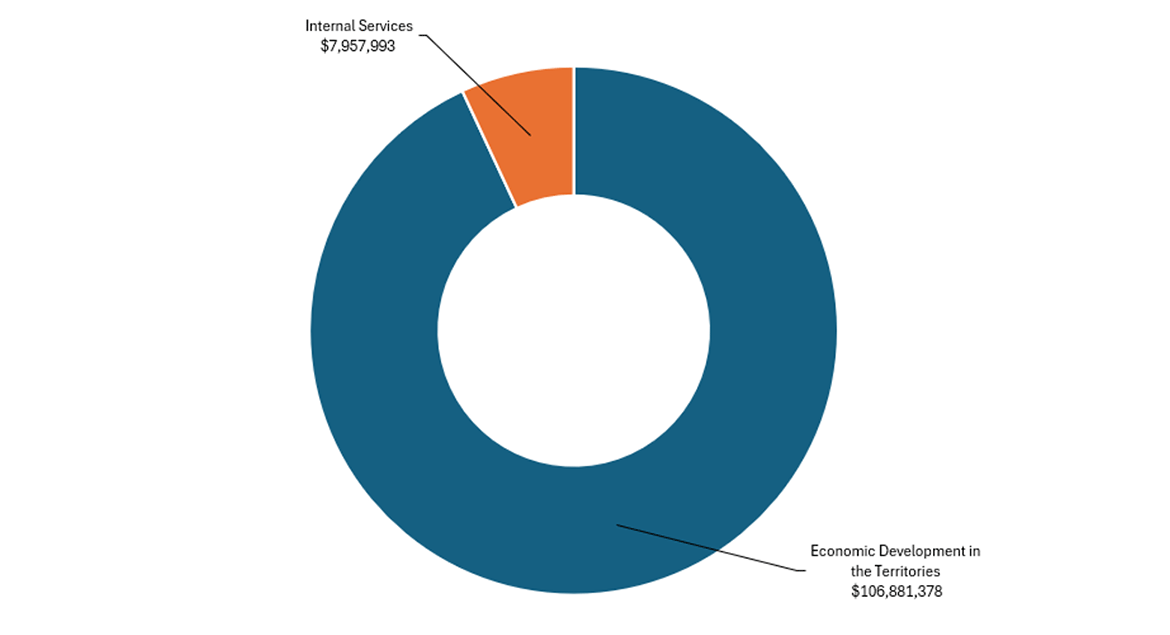
Text alternative for Graph 1 Planned spending by core responsibility in 2026-27
| Core responsibilities and internal services | 2026-27 planned spending |
|---|---|
| Economic Development in the Territories | $106,881,378 |
| Internal services | $7,957,993 |
Analysis of planned spending by core responsibility
For 2026-27, CanNor has allocated approximately 92% of its total budget to deliver Economic Development in the Territories. The remaining 8% of the total budget is used to fund Internal Services to support program delivery. CanNor will continue supporting Northerners as they seize economic opportunities, promote economic innovation and diversification, build capacity and develop skilled workforces, and encourage job growth by making strategic investments.
Budgetary performance summary
Table 5 Three-year spending summary for core responsibilities and internal services (dollars)
Table 5 presents CanNor's spending over the past three years to carry out its core responsibilities and for internal services. Amounts for the 2025-26 fiscal year are forecasted based on spending to date.
| Core responsibilities and Internal services | 2023-2024 Actual Expenditures | 2024-25 Actual Expenditures | 2025-2026 Forecast Spending |
|---|---|---|---|
| Economic Development in the Territories | $78,143,504 | $72,244,695 | $95,723,164 |
| Subtotal (s) | $78,143,504 | $72,244,695 | $95,723,164 |
| Internal Services | $9,241,793 | $8,731,676 | $9,728,869 |
| Total (s) | $87,385,297 | $80,976,370 | $105,452,033 |
Analysis of the past three years of spending
Actual expenditures and forecast spending for fiscal years 2023-2024 to 2025-2026 reflect all parliamentary appropriations, including the Main Estimates, Supplementary Estimates, and funding from the various Treasury Board votes. Variances across this period reflect the transition from time-limited stimulus measures to more targeted, strategically aligned investments supporting northern infrastructure readiness, economic resilience, and Arctic sovereignty priorities.
The decrease in spending between the fiscal years 2023-2024 and 2024-2025 is primarily attributable to the sunsetting of temporary funding measures announced in Budget 2021, including the Jobs and Growth Fund and the Canada Community Revitalization Fund. The increase in forecasted spending between 2024-2025 and 2025-2026 reflects targeted transfer payment funding approved through Supplementary Estimates (B), including investments for the Yukon Gathering Place, RDII, and RTRI. These investments support strengthened northern participation in defence-related supply chains, improved economic resilience in the face of global trade disruptions, and regionally responsive infrastructure and community development priorities.
More financial information from previous years is available on the Finances section of GC Infobase.
Table 6 Planned three-year spending on core responsibilities and internal services (dollars)
Table 6 presents CanNor's approved planned spending over the next three fiscal years by core responsibilities and for internal services.
| Core responsibilities and Internal services | 2026-27 Planned Spending | 2027-28 Planned Spending | 2028-29 Planned Spending |
|---|---|---|---|
| Economic Development in the Territories | $106,881,378 | $77,815,782 | $39,096,433 |
| Subtotal | $106,881,378 | $77,815,782 | $39,096,433 |
| Internal services | $7,957,993 | $5,568,109 | $5,331,332 |
| Total | $114,839,371 | $83,383,891 | $44,427,765 |
Analysis of the next three years of spending
Approved planned spending over the next three fiscal years reflects a gradual year-over-year decrease due to the scheduled sunsetting of several time-limited initiatives after 2026-27, including the IDEANorth renewal, the Renewed Food Policy for Canada, and temporary enhancements to NIEOP.
These reductions reflect the conclusion of targeted, time-bound funding measures rather than a change to CanNor's core mandate. Within this evolving fiscal context, the Agency will prioritize disciplined allocation of remaining resources toward high-impact investments that strengthen project readiness, Indigenous economic participation, regulatory coordination, and northern supply chain resilience.
More detailed financial information on planned spending is available on the Finances section of GC Infobase.
Funding
This section provides an overview of the department's voted and statutory funding for its core responsibilities and for internal services. For further information on funding authorities, consult the Government of Canada budgets and expenditures.
Graph 2 summarizes the department's approved voted and statutory funding from fiscal year 2023-24 to 2028-29.
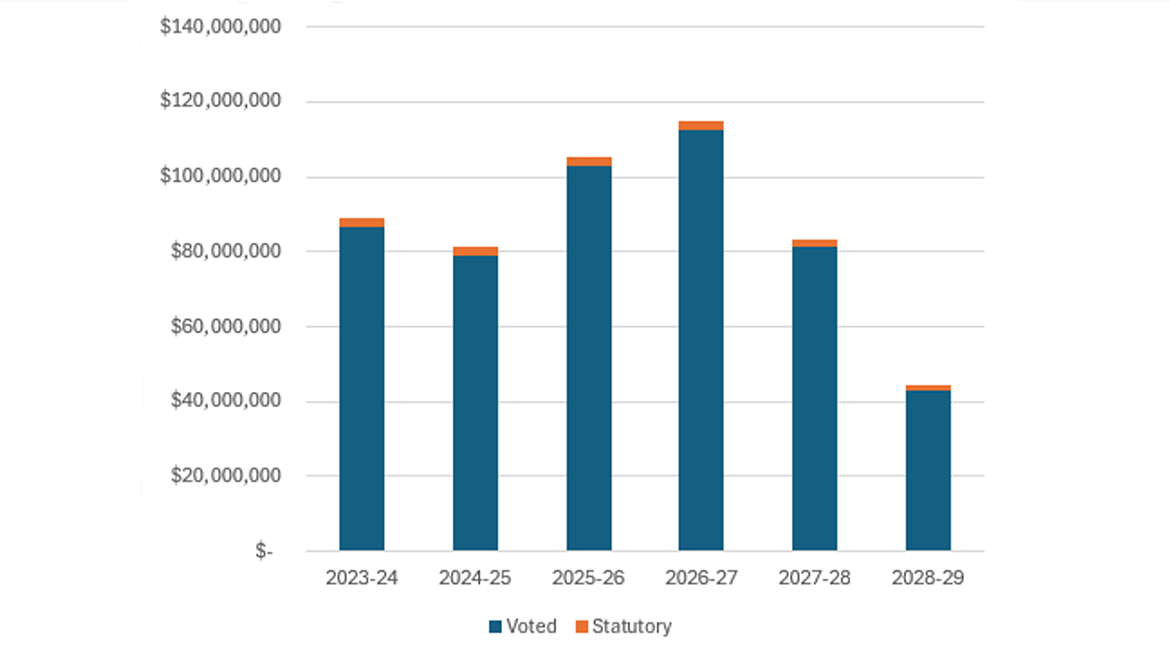
Text alternative for Graph 2: Approved funding (statutory and voted) over a six-year period
| Fiscal year | Total | Voted | Statutory |
|---|---|---|---|
| 2023-24 | $88,793,848 | $86,653,451 | $2,140,214 |
| 2024-25 | $81,347,545 | $79,162,565 | $2,184,980 |
| 2025-26 | $105,452,033 | $102,810,614 | $2,641,419 |
| 2026-27 | $114,839,371 | $112,473,467 | $2,365,904 |
| 2027-28 | $83,383,891 | $81,478,106 | $1,905,785 |
| 2028-29 | $44,427,765 | $42,934,856 | $1,492,909 |
Analysis of statutory and voted funding over a six-year period
Approved funding for fiscal years 2023-24 to 2025-26 reflects both Main Estimates and Supplementary Estimates authorities. Planned funding for fiscal years 2026-27 to 2028-29 reflects Main Estimates authorities only and does not include potential future adjustments through Supplementary Estimates or Budget decisions.
The year-over-year decrease from 2025-26 reflects the scheduled sunsetting of several time-limited initiatives, including the Regional Economic Growth through Innovation (REGI) program, the Tourism Growth Program, the IDEANorth renewal, the Renewed Food Policy for Canada, and temporary enhancements to NIEOP.
These changes reflect the conclusion of targeted funding measures rather than a reduction in CanNor's core mandate. Within this fiscal framework, the Agency will continue to prioritize strategic investments that strengthen economic resilience, project readiness, Indigenous economic participation, regulatory coordination, and northern supply chain development.
For further information on CanNor's departmental appropriations, consult the 2026-27 Main Estimates
Future-oriented condensed statement of operations
The future-oriented condensed statement of operations provides an overview of CanNor's operations for fiscal years 2025-26 to 2026-27.
Table 8 Future-oriented condensed statement of operations for the year ended March 31, 2027 (dollars)
Table 8 summarizes the expenses and revenues that net to the cost of operations, before government funding and transfers for fiscal years 2025-26 to 2026-27. The forecast and planned amounts in this statement of operations were prepared on an accrual basis. The forecast and planned amounts presented in other sections of the Departmental Plan were prepared on an expenditure basis. Amounts may therefore differ.
| Financial information | 2025-26 Forecast results | 2026-27 Planned results | Difference (Planned results minus forecasted) |
|---|---|---|---|
| Total expenses | $105,452,033 | $114,839,371 | $9,387,338 |
| Total revenues | $11,400 | $4,302 | $7,098 |
| Net cost of operations before government funding and transfers | $105,440,633 | $114,835,069 | $9,394,436 |
Analysis of forecasted and planned results
Total planned expenses for fiscal year 2026-27 are $114.8 million, an increase of $9.4 million compared to the 2025-26 forecast of $105.4 million. The growth is from the addition of RDII, funding for the Yukon Gathering Place, and RTRI. It is partially offset by the scheduled sunsetting of time-limited initiatives, including funding for the Tourism Growth Program (Budget 2023) and the REGI program (Budget 2024), both of which were included in CanNor's approved Comprehensive Expenditure Review (CER) reductions.
This reflects the conclusion of targeted funding measures rather than a change to CanNor's core mandate. Within this fiscal framework, the Agency will continue to prioritize disciplined, high-impact investments that support project readiness, Indigenous economic participation, regulatory coordination, and northern economic resilience.
A more detailed Future-Oriented Statement of Operations and associated Notes for 2026-27, including a reconciliation of the net cost of operations with the requested authorities, is available on CanNor's website.
Human resources
This section presents an overview of the department's actual and planned human resources from fiscal years 2023-24 to 2028-29.
Table 9: Actual human resources for core responsibilities and internal services
Table 9 shows a summary of human resources, in full-time equivalents, for CanNor's core responsibilities and for its internal services for the previous three fiscal years. Human resources for the 2025-26 fiscal year are forecasted based on year to date.
| Core responsibilities and internal services | 2023-24 Actual full-time equivalents | 2024-25 Actual full-time equivalents | 2025-26 Forecasted full-time equivalents |
|---|---|---|---|
| Economic Development in the Territories | 83 | 86 | 97 |
| Subtotal | 83 | 86 | 97 |
| Internal services | 33 | 30 | 33 |
| Total | 116 | 116 | 130 |
Analysis of human resources over the last three years
The increase in forecasted full-time equivalents (FTEs) for 2025-26 compared to 2024-25 reflects both the filling of previously vacant positions (7% vacancy rate in 2024-25) and the addition of six FTEs approved through the 2025-26 Supplementary Estimates (B).
The increase in staffing levels reflects efforts to stabilize workforce capacity and align internal resources with evolving northern priorities.
Table 10: Human resources planning summary for core responsibilities and internal services
Table 10 shows information on human resources, in full-time equivalents, for each of CanNor's core responsibilities and for its internal services planned for the next three fiscal years.
| Core responsibilities and internal services | 2026-27 Planned full-time equivalents | 2027-28 Planned full-time equivalents | 2028-29 Planned full-time equivalents |
|---|---|---|---|
| Economic Development in the Territories | 96 | 82 | 76 |
| Subtotal | 96 | 82 | 76 |
| Internal services | 32 | 28 | 27 |
| Total | 128 | 110 | 103 |
Analysis of human resources for the next three years
Planned FTE levels increase in 2026-27 to 128 to support previously approved priority initiatives, including the RDII, the RTR), and strengthened regulatory coordination and project readiness functions. This temporary increase aligns staffing capacity with heightened demand related to infrastructure sequencing, defence-related economic participation, and economic resilience measures.
FTE levels decline beginning in 2027-28, reflecting the scheduled sunsetting of time-limited initiatives, including IDEANorth, the Tourism Growth Program, and temporary enhancements to the NIEOP, as well as CER reductions and adjustments to base funding.
The planned reduction to 103 FTEs by 2028-29 reflects a managed transition to a streamlined operating structure focused on core mandate delivery, disciplined resource allocation, and high-impact economic development priorities.
Supplementary information tables
The following supplementary information tables are available on CanNor's website:
Information on CanNor's departmental sustainable development strategy can be found on CanNor's website.
Federal tax expenditures
CanNor's Departmental Plan does not include information on tax expenditures.
The tax system can be used to achieve public policy objectives through the application of special measures such as low tax rates, exemptions, deductions, deferrals and credits. The Department of Finance Canada publishes cost estimates and projections for these measures each year in the Report on Federal Tax Expenditures.
This report also provides detailed background information on tax expenditures, including descriptions, objectives, historical information and references to related federal spending programs as well as evaluations and GBA Plus of tax expenditures.
Corporate information
Departmental profile
Appropriate minister(s):
The Honourable Rebecca Chartrand, Minister of Northern and Arctic Affairs and Minister responsible for the Canadian Northern Economic Development Agency
Institutional head
Jimi Onalik, President
Ministerial portfolio:
Canadian Northern Economic Development Agency
Enabling instrument(s):
Public Service Rearrangement and Transfer of Duties Act, R.S.C. 1985, c. P-34
Year of incorporation / commencement:
2009Other:
NoneDepartmental contact information
Mailing address:
200 - 1106 Iqaluktuutiak Drive Iqaluit, Nunavut X0A 3H0 Canada
Telephone:
Fax:
613-995-9495
Email:
Website(s):
Canadian Northern Economic Development AgencyDefinitions
List of terms
- appropriation (crédit)
- Any authority of Parliament to pay money out of the Consolidated Revenue Fund.
- budgetary expenditures (dépenses budgétaires)
- Operating and capital expenditures; transfer payments to other levels of government, departments or individuals; and payments to Crown corporations.
- core responsibility (responsabilité essentielle)
- An enduring function or role performed by a department. The intentions of the department with respect to a core responsibility are reflected in one or more related departmental results that the department seeks to contribute to or influence.
- Departmental Plan (Plan ministériel)
- A report on the plans and expected performance of an appropriated department over a 3year period. Departmental Plans are usually tabled in Parliament each spring.
- departmental result (résultat ministériel)
- A consequence or outcome that a department seeks to achieve. A departmental result is often outside departments' immediate control, but it should be influenced by program-level outcomes.
- departmental result indicator (indicateur de résultat ministériel)
- A quantitative measure of progress on a departmental result.
- Departmental Results Framework (Cadre ministériel des résultats)
- A framework that connects the department's core responsibilities to its departmental results and departmental result indicators.
- Departmental Results Report (Rapport sur les résultats ministériels)
- A report on a department's actual accomplishments against the plans, priorities and expected results set out in the corresponding Departmental Plan.
- full-time equivalent (équivalent temps plein)
- A measure of the extent to which an employee represents a full person-year charge against a departmental budget. For a particular position, the full-time equivalent figure is the ratio of number of hours the person actually works divided by the standard number of hours set out in the person's collective agreement.
- Gender-Based Analysis Plus (GBA Plus) (analyse comparative entre les sexes plus [ACS Plus])
An analytical tool used to support the development of responsive and inclusive policies, programs, and other initiatives. GBA Plus is a process for understanding who is impacted by the issue or opportunity being addressed by the initiative; identifying how the initiative could be tailored to meet diverse needs of the people most impacted; and anticipating and mitigating any barriers to accessing or benefitting from the initiative. GBA Plus is an intersectional analysis that goes beyond biological (sex) and socio-cultural (gender) differences to consider other factors, such as age, disability, education, ethnicity, economic status, geography (including rurality), language, race, religion, and sexual orientation.
Using GBA Plus involves taking a gender- and diversity-sensitive approach to our work. Considering all intersecting identity factors as part of GBA Plus, not only sex and gender, is a Government of Canada commitment.
- government priorities (priorités gouvernementales)
- For the purpose of the 2026-27 Departmental Plan, government priorities are the high-level themes outlining the government's agenda in the 2025 Speech from the Throne.
- horizontal initiative (initiative horizontale)
- An initiative where two or more federal departments are given funding to pursue a shared outcome, often linked to a government priority.
- Indigenous business (entreprise autochtones)
- Requirements for verifying Indigenous businesses for the purposes of the departmental result report are available through the Indigenous Services Canada Mandatory minimum 5% Indigenous procurement target website.
- non‑budgetary expenditures (dépenses non budgétaires)
- Non-budgetary authorities that comprise assets and liabilities transactions for loans, investments and advances, or specified purpose accounts, that have been established under specific statutes or under non-statutory authorities in the Estimates and elsewhere. Non-budgetary transactions are those expenditures and receipts related to the government's financial claims on, and obligations to, outside parties. These consist of transactions in loans, investments, and advances; in cash and accounts receivable; in public money received or collected for specified purposes; and in all other assets and liabilities. Other assets and liabilities, not specifically defined in G to P authority codes are to be recorded to an R authority code, which is the residual authority code for all other assets and liabilities.
- performance (rendement)
- What a department did with its resources to achieve its results, how well those results compare to what the department intended to achieve, and how well lessons learned have been identified.
- performance indicator (indicateur de rendement)
- A qualitative or quantitative means of measuring an output or outcome, with the intention of gauging the performance of a department, program, policy, or initiative respecting expected results.
- plan (plan)
- The articulation of strategic choices, which provides information on how a department intends to achieve its priorities and associated results. Generally, a plan will explain the logic behind the strategies chosen and tend to focus on actions that lead to the expected result.
- planned spending (dépenses prévues)
For Departmental Plans and Departmental Results Reports, planned spending refers to those amounts presented in Main Estimates.
A department is expected to be aware of the authorities that it has sought and received. The determination of planned spending is a departmental responsibility, and departments must be able to defend the expenditure and accrual numbers presented in their Departmental Plans and Departmental Results Reports.
- program (programme)
- Individual or groups of services, activities or combinations thereof that are managed together within the department and focus on a specific set of outputs, outcomes or service levels.
- program inventory (répertoire des programmes)
- Identifies all the department's programs and describes how resources are organized to contribute to the department's core responsibilities and results.
- result (résultat)
- A consequence attributed, in part, to a department, policy, program or initiative. Results are not within the control of a single department, policy, program or initiative; instead, they are within the area of the department's influence.
- statutory expenditures (dépenses législatives)
- Expenditures that Parliament has approved through legislation other than appropriation acts. The legislation sets out the purpose of the expenditures and the terms and conditions under which they may be made.
- target (cible)
- A measurable performance or success level that a department, program or initiative plans to achieve within a specified time period. Targets can be either quantitative or qualitative.
- voted expenditures (dépenses votées)
- Expenditures that Parliament approves annually through an appropriation act. The vote wording becomes the governing conditions under which these expenditures may be made.