2025 - Ministerial transition binder - The Honourable Rebecca Chartrand
Table of contents
CanNor Welcome Letter
The Honourable Rebecca Chartrand
Minister of Northern and Arctic Affairs and Minister responsible for the Canadian Northern
Economic Development Agency
House of Commons
Ottawa, Ontario
Dear Minister,
Congratulations on your appointment as Minister of Northern and Arctic Affairs and Minister responsible for the Canadian Northern Economic Development Agency (CanNor), which serves Nunavut, the Northwest Territories, and Yukon as one of seven (7) federal Regional Development Agencies.
Based in the North, for the North, CanNor's mandate is focused on building diversified and dynamic economies that foster long-term sustainability and prosperity across the territories, which contributes to Canada's success. CanNor has a committed team across four offices in Iqaluit (headquarters), Yellowknife, Whitehorse, and Ottawa, who work together with partners to leverage opportunities and address challenges.
CanNor plays a key role as the Regional Development Agency for the territories. These agencies are grounded and trusted in the regions they serve, and act as catalyzers and connectors to facilitate increases in resilient and competitive businesses, the creation of high-quality jobs, the development of a skilled workforce, and investments in economic diversification and innovation. CanNor fully supports the advancement of Indigenous economic reconciliation while working to close the North's infrastructure gap, advance sustainable resource development and secure Arctic sovereignty.
Since 2009, CanNor has approved over $700 million in investments towards more than 2,100 projects through its suite of targeted funding programs for non-profits, Indigenous organizations, other levels of government, businesses, and economic development corporations.
In recognizing CanNor's unique role in the North, it offers two unique services: Pilimmaksaivik, the Federal Centre of Excellence for Inuit Employment in Nunavut, and the Northern Projects Management Office, which supports impact assessment for proposed large projects. These services provide CanNor additional tools to deliver on its core mandate of advancing economic development in the territories.
The North is contending with several converging headwinds, from trade tariffs to climate change to increased foreign interest in the Arctic. CanNor's experience in delivering programs and services in the North will play a critical role in supporting northern economies and communities through this period of instability and work to support the Government's agenda for the North.
On behalf of everyone at CanNor, I welcome you and look forward to assisting you in your new role as our Minister.
Sincerely,
Jimi Onalik
President
Minister's first key messages about CanNor
- I am pleased to become the Minister Responsible for the Canadian Northern Economic Development Agency (CanNor).
- CanNor helps the Northern economy grow stronger and more resilient by supporting the North in contributing to a strong Canadian economy across multiple sectors, including tourism, fisheries, natural resources, agriculture and food systems, as well as arts and culture. The North also holds vast potential within the blue economy, cold climate innovation, and renewable energy.
- Our government recognizes the North's economic potential and its importance to Canada's sovereignty and security. We are committed to working in partnership with Territorial and Indigenous Governments and organizations, local communities, businesses, and entrepreneurs to foster sustainable, diversified, resilient and innovative northern economies. A thriving North means a thriving Canada.
- As Canada's Regional Development Agency (RDA) for the Territories, CanNor works at the community level to support high impact economic development. At the Government of Canada level, the Agency is a hub for delivering federal programs, supports regulatory processes in the North, and provides strategic intelligence on Arctic issues to help manage risk.
- With its headquarters in the North, CanNor is uniquely positioned to understand and respond to northern realities. Our work supports communities across the Northwest Territories, Yukon and Nunavut.
- CanNor works to grow the Indigenous workforce to be ready for opportunities, invests in start-ups and business growth, supports communities' economic resilience and development, as well as facilitate partnerships and collaborative projects.
- In the face of current economic uncertainty, we are focused on building resilience amongst businesses, while continuing to empower more entrepreneurs and innovators to put their ideas to work, creating good-paying and meaningful jobs and keeping the North and Canada at the economic forefront.
Key decisions and actions over the next 90 days, 6 months and 1 year timelines
90 days
Renewal of the delegation of financial authorities
Timeline: Within 90 days of the Minister being appointed
The Financial Administration Act and regulations require the written delegation of authorities from a Minister to public service officials. These authorities are established with a view to ensuring that appropriate financial and operational management controls are applied to the decision-making process in spending public monies, and that these controls contribute to the effectiveness of program delivery and the accountability of the authority process.
[redacted]
Signing of the 2025-26 Departmental Plan
Timeline: TBC, expected to be soon after new Parliament is formed
The Departmental Plan is your department's spending plan for a new fiscal year. It also describes your department's priorities, planned results and associated resource requirements for a three year period. It is typically tabled at the beginning of a calendar year, but was delayed due to the prorogation and then dissolution of the previous Parliament.
CanNor's plan was recently approved by the previous Minister, but was not tabled. The plan has since been updated to your appointment and requires your signature.
The President of Treasury Board is expected to table all plans sometime after the new Parliament session begins.
Project bundle approvals
Timeline: Typically monthly
Ministerial approval is required for projects with a contribution agreement above $100,000. CanNor brings forward projects for ministerial approval in monthly "bundles." CanNor solicits project proposals through an expression of interest (EOI) process. The EOI period for projects to start funding in 2025-26 fiscal year was open October 15 – November 18, 2024. The first "bundle" of 2025-26 projects for ministerial approval is expected in late Spring, 2025.
6 months – 1 year
[redacted]
Departmental sustainable development strategy progress report
Timeline: Target (Fall 2025)
The Federal Sustainable Development Act requires that Ministers direct their departments to prepare a sustainable development strategy, containing objectives and plans, which comply with the Federal Sustainable Development Strategy (FSDS) and contributes to the meeting of its goals. CanNor tabled a Departmental Sustainable Development Strategy (DSDS) in November 2023.
Departments also table an annual progress report on the DSDS - CanNor previously published this report in October 2024 and an update must be tabled by October 2025.
Access to Information Act and the Privacy Act annual reports
Timeline: Target (September 2025)
The Access to Information Act (ATIA) and of the Privacy Act (PA) stipulate that the head of every government institution must prepare annual reports for submission to Parliament on the administration of both Acts within their institution for each financial year. CanNor will prepare these reports, which will require Ministerial approval prior to being tabled in Parliament in September 2025.
Departmental Results Report
Timeline: TBC
The Departmental Results Report is your department's account of actual performance, for the most recently completed fiscal year, against the plans, priorities and expected results set out in the Departmental Plan.
[redacted]
Recent briefings and decisions for ministerial awareness
Briefing note for Main Estimates
Timeline: Shared with previous Minister for information; Main Estimates not tabled
The Estimates, which need to be voted on by Parliament, set out the government's detailed projected expenditures for the upcoming fiscal year. They specify the amounts and purposes for which departments and agencies can spend appropriated funds. The Estimates process is how departments receive supply, thus having funds to operate.
Note: There are alternative tools that can be invoked to maintain funding temporarily, including interim supply (a mechanism commonly used to provide continued funding while the House considers the main estimates) or the Governor General's Special Warrants.
[redacted]
Key issues
[redacted]
CanNor and the Territories 101

Picture taken by Pierre Barrieau, ASAinc
Canada's territories are home to:
- 0.32% of Canada's population spread across 40% of the nation's landmass.
- A younger population: 60% of the northern population is under 40, compared to 48% of the Canadian population.
- A high proportion of Indigenous Peoples: 52.7% of the population in the territories identified as Indigenous in 2021, versus 5.0% across Canada.
Population by territory:
- Yukon: 46,704
- Northwest Territories: 44,731
- Nunavut: 41,159
Compared to the provinces, the populations of the Yukon, the Northwest Territories, and Nunavut are quite small. However, they are spread across a sizeable portion of Canada's territory.
Sources: Statistics Canada, Census 2021; Statistics Canada, Table 17-10-0005-01.
The resource sector is the cornerstone of the northern economy, with the mining industry contributing to 20% of the GDP in 2024.
GDP by Sector, 2024:
- Public Sector 35%
- Mining, Quarrying, and Oil and Gas Extraction 20%
- Construction 9%
- Real Estate, Rental, & Leasing 11%
- Retail Trade 4%
- Transportation & Warehousing 4%
- Arts, Information, & Culture 3%
- Accommodation & Food Services 3%
- Other 11%
The territorial economies have:
- Varying unemployment rates that fluctuate based on factors such as seasonal employment and limited sectoral diversification: Nunavut tends to surpass the national unemployment rate, with NWT oscillating close to it. Yukon tends to remain well below the national average.
- Lower rates of employment among Indigenous populations (as of 2024): 50.0% of the Indigenous population was employed compared to 78.0% of the non-Indigenous population.
- Significant differences among the three territories, with Yukon having a relatively developed transportation network and mature economy, Nunavut facing greater challenges, and the Northwest Territories somewhere in the middle.
Sources: Statistics Canada Labour Force Survey 2024, Statistics Canada, Table 14-10-0446-01; Statistics Canada Table 36-10-0402-01.
CanNor is one of 7 Regional Development Agencies (RDAs)
- Canadian Northern Economic Development Agency (CanNor) – Canada's RDA for the territories
- Pacific Economic Development Canada (PacifiCan)
- Prairies Economic Development Canada (PrairiesCan)
- Federal Economic Development Agency for Northern Ontario (FedNor)
- Canada Economic Development for Quebec Regions (CED)
- Atlantic Canada Opportunities Agency (ACOA)
- Federal Economic Development Agency for Southern Ontario (FedDev)
CanNor by the numbers:
- 124 FTEs
- 2 specialty branches: Pilimmaksaivik and the Northern Projects Management Office
- $66.3 M budgetFootnote 1
- 4 offices: Iqaluit headquarters, regional offices in Whitehorse and Yellowknife, and a liaison office in Ottawa
CanNor's unique role (as compared to other RDAs)
Northern Economic Development
- CanNor is the only federal agency dedicated to the economic development of the territories
- It plays several key roles including as an investor, advisor, convenor, and pathfinder.
Northern Indigenous Economic Opportunities Program
- CanNor is the only RDA to have a program specifically targeted to Indigenous economic development - Northern Indigenous Economic Opportunities Program (NIEOP).
- NIEOP supports greater participation by Inuit, First Nations and Métis communities and businesses to equip them to better pursue economic opportunities.
Northern Projects Management Office
- Through our Northern Projects Management Office (NPMO), CanNor facilitates northern regulatory processes by coordinating federal participation.
- NPMO's key services include:
- providing single-window federal coordination and issues management;
- coordinating and maintaining the record of Crown consultations associated with major projects; and
- convening meetings and forums with industry, territorial governments, Indigenous governments and organizations, regulatory boards, and stakeholders to address and resolve issues.
Pilimmaksaivik
- The Government of Canada is obligated by Article 23 of the Nunavut Agreement to support the objective of building a "representative" public service in Nunavut (i.e., 85% of positions to be filled by Inuit).
- Housed within CanNor, Pilimmaksaivik (the Federal Centre of Excellence for Inuit Employment in Nunavut) supports nine federal departments and agencies with Article 23 obligations, plus two special operating agencies, and works closely with central agencies regarding employment in Nunavut.
We deliver on Government of Canada priorities through funding, advocacy and collaboration.
Internal Policy Priorities:
- Pan-Territorial Growth Strategy:
- Skilled Workforce
- Infrastructure Development
- Resource Development
- Innovation and Diversification
- The Speech from the Throne: Speeches from the Throne
- Mandate Letters: Mandate Letters | Prime Minister of Canada
- New Priorities (e.g. housing, critical minerals and affordability)
- National Housing Strategy: Housing, Infrastructure and Communities Canada - Canada's National Housing Strategy
Government of Canada
- Inuit Nunangat Policy: Inuit Nunangat Policy
- Arctic & Northern Policy Framework: Arctic and Northern Policy Framework
- Canadian Critical Minerals Strategy: The Canadian Critical Minerals Strategy
We also take into account the priorities of Territorial and Indigenous partners, Industry and impacted stakeholders, such as:
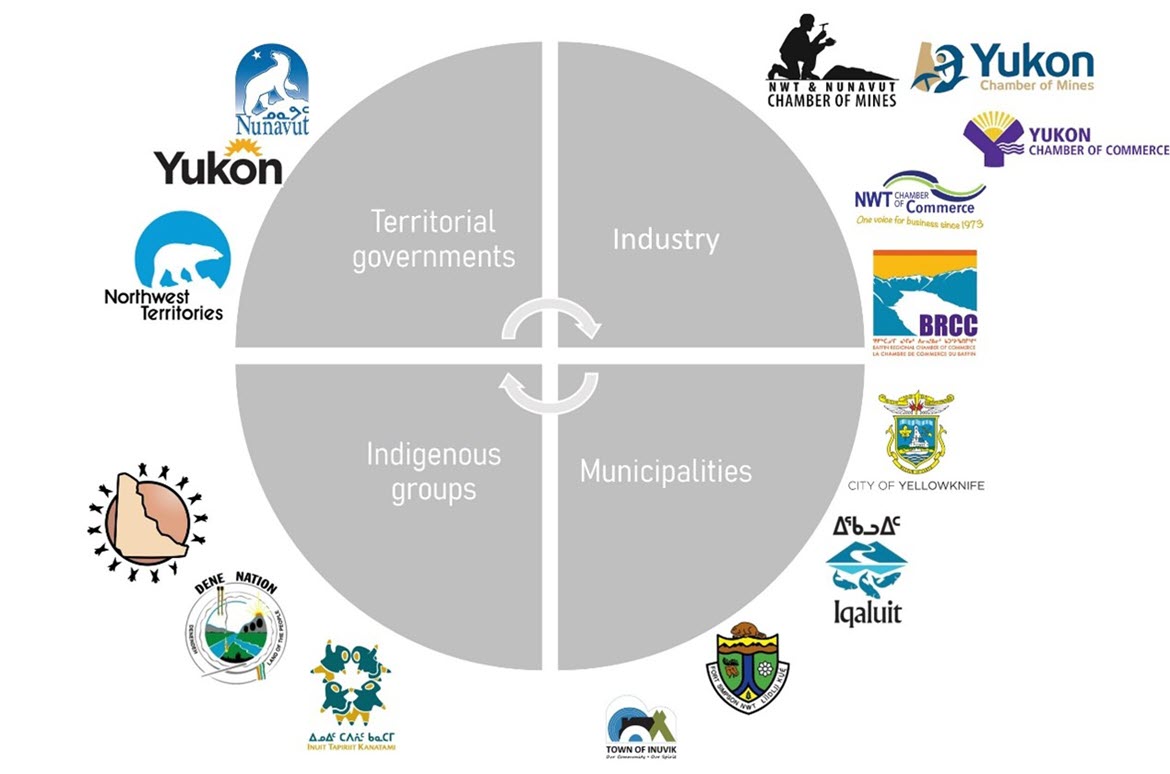
Text alternative
A circle featuring various logos of territorial governments, industrial groups, municipalities, and Indigenous groups, with arrows pointing in a clockwise direction.
Here is the breakdown:
- Territorial Governments:
- Government of Yukon
- Government of Northwest Territories
- Government of Nunavut
- Industry:
- NWT & Nunavut Chamber of Mines
- Yukon Chamber of Mines
- Yukon Chamber of Commerce
- NWT Chamber of Commerce
- Baffin Regional Chamber of Commerce
- Municipalities:
- City of Yellowknife
- City of Iqaluit
- Town of Fort Simpson
- Town of Inuvik
- Indigenous groups:
- Inuit Tapiriit Kanatami
- Dene Nation
- Council of Yukon First Nations
CanNor's footprint
Key CanNor programsFootnote 2
Flagship program:
- Inclusive Diversification and Economic Advancement in the North (IDEANorth): Makes foundational investments in economic infrastructure, sector development, and capacity-building.
National programs delivered by CanNor:
- Regional Economic Growth Through Innovation (REGI): Supports the development of regional innovation ecosystems and business scale-up.
- Economic Development Initiative (EDI): Supports projects that encourage economic diversification, development, or innovation, for SMEs in official language minority communities (OLMCs).
CanNor spending and human resources summary 2021–22 to 2026–27Footnote 3
| Year | 2021-22 | 2022-23 | 2023-24 | 2024-25 | 2025-26 | 2026-27 |
|---|---|---|---|---|---|---|
| Statutory | $1,836,511 | $1,861,614 | $2,140,214 | $2,131,509 | $2,083,184 | $1,664,391 |
| Voted | $86,535,003 | $103,215,729 | $85,218,083 | $69,256,467 | $64,237,968 | $60,094,640 |
| Total | $88,371,514 | $105,077,343 | $87,358,297 | $71,387,976 | $66,321,152 | $61,759,031 |
| Core responsibilities and internal services | 2021–22 actual FTEs | 2022–23 actual FTEs | 2023–24 actual FTEs |
|---|---|---|---|
| Economic development in the territories | 89 | 80 | 83 |
| Internal services | 29 | 32 | 33 |
| Total | 118 | 112 | 116 |
| Note: The year-over-year changes in actual full-time equivalents are mainly due to staff turnover. | |||
The following table shows information on human resources, in full-time equivalents (FTEs), for each of CanNor's core responsibilities and for its internal services planned for 2024–25 and future years.
| Core responsibilities and internal services | 2024–25 planned fulltime equivalents | 2025–26 planned fulltime equivalents | 2026–27 planned fulltime equivalents |
|---|---|---|---|
| Economic development in the territories | 93 | 93 | 92 |
| Internal services | 31 | 31 | 31 |
| Total | 124 | 124 | 123 |
| Note: The planned FTEs are stabilized for the next three years based on the Budget 2023's renewal of the CanNor's flagship program: Inclusive Diversification and Economic Advancement in the North. | |||
Recent new funding
Regional Economic Growth Through Innovation (REGI)
- $158.5 million over two years across all RDAs, to include $50 million over two years for Innovative Housing starting in 2024-25.
- CanNor allocation: $10.9 million over two years ($300K over two years will be dedicated to Innovative Housing).
- Treasury Board submission led by Atlantic Canada Opportunities Agency (using CEAA process). Approved October 10, 2024.
Building on Canada's AI Advantage
- $200 million over five years across all RDAs. Funding to be delivered by RDAs as follows:
- $15 million (2024-25); $35 million (2025-26); $50 million (2026-27); $50 million (2027-28); $50 million (2028-29).
- CanNor allocation: $4.1 million over five years.
- Treasury Board submission led by FedDev Ontario (using CEAA process). Approved October 10, 2024.
Northern Isolated Community Initiatives (NICI)
- $103.9 million over three years, starting in 2024-25, in support of a renewed Food Policy for Canada, which includes $14.9 million over three years for NICI, starting in 2024-25, across the three RDAs responsible for regions of Inuit Nunangat.
- CanNor allocation: $9 million over three years.
- Funding to be provided to CEDQ ($4.1 million over three years) and ACOA ($1.8 million over three years).
- Treasury Board submission led by AAFC (approved by Treasury Board on June 13, 2024).
Pilimmaksaivik:
- The Federal Government with the Government of Nunavut and Nunavut Tunngavik Inc. (NTI) signed the Nunavut Agreement Implementation Contract that commits $1.5 billion from 2024 to 2034, and $77.6 million per year ongoing to support NTI, the Government of Nunavut, the five Institutions of Public Government, and Pilimmaksaivik.
[redacted]
CanNor's Announcements & Transparency Information Are Available on Our Website
CanNor's Organizational Chart
- Jimi Onalik: President (Deputy Minister); Iqaluit & Ottawa
- Chamika Ailapperuma: Chief of Staff and Senior Advisor; Ottawa
- David Lawson: DG, Pilimmaksaivik; Iqaluit
- Kate Durand: VP, Pan-Territorial Operations; Whitehorse
- Jacqueline Lalonde: Regional Director; Yellowknife
- Robert Aubé: Regional Director; Iqaluit
- Judith Bosire: Director, Pan-territorial Programs and Services; Iqaluit
- Torrine Johnson: Regional Director; Whitehorse
- Stephen Traynor: VP, Policy, Planning, Communications, & NPMO; Ottawa
- Michael Walsh: DG, Policy and Planning, Ottawa
- Stéphane Pronovost: Director, Strategic Policy & Planning; Ottawa
- Laura Way: Director, Program Policy, Research and Evaluation; Ottawa
- Lisa Dyer: DG, NPMO; Yellowknife
- Adrian Paradis: Projects Director, NPMO; Yellowknife
- Marie-Eve LaRocque: Director, Communications; Yellowknife
- Julie-Anne Miller: Senior Advisor and Corporate Secretary; Ottawa
- Michael Walsh: DG, Policy and Planning, Ottawa
- Sean O'Donnell: DG, Corporate Services and CFO; Ottawa